


- What neuroplasticity actually means
- Neuroplasticity: how to rewire your brain for a better life
- Your brain changes around what you repeat
- How to actually rewire your brain
- Why emotion speeds learning
- The habits that support brain change
- What gets in the way
- A more realistic way to think about brain rewiring
You can feel your brain shaping your life long before you understand the science. It shows up when stress sends you straight into the same old reaction, when one small win makes the next healthy choice easier, or when a breakup, burnout, or big move seems to change how you think from the inside out. That is the real territory of neuroplasticity: how to rewire your brain for a better life. Not through wishful thinking or self-help slogans, but through repeated experience that teaches the brain what to expect, notice, and do next.
What neuroplasticity actually means
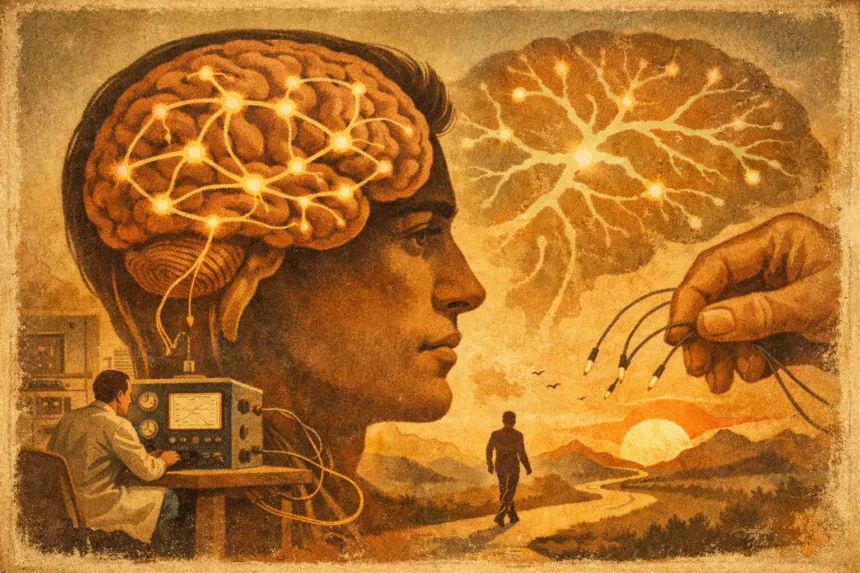
Neuroplasticity is the brain’s ability to change its structure and function in response to experience. That can sound dramatic, but the basic idea is simple: the brain is not fixed. Neural pathways strengthen with use, weaken with disuse, and reorganize when your environment, attention, and behavior change.
This is one reason habits feel so automatic. Repeated thoughts and actions become efficient because the brain is designed to conserve energy. If you worry the same way every day, procrastinate in the same situations, or calm yourself by reaching for your phone every time discomfort shows up, those patterns become easier to repeat. The opposite is also true. New ways of responding can become more natural over time, but only with enough repetition to compete with the old pathway.
That last part matters because neuroplasticity gets oversold. People often talk about it as if your brain is infinitely editable and all change is just a mindset shift away. It is not that simple. The brain can change, but it changes under constraints. Age, stress, sleep, trauma history, mental health conditions, and environment all affect how easy change feels.
Neuroplasticity: how to rewire your brain for a better life
If you want to use neuroplasticity well, stop thinking in terms of massive reinvention and start thinking in terms of training. Your brain is always learning from what you repeatedly do, feel, and pay attention to. The real question is whether that learning is helping you.
A better life, psychologically speaking, usually depends on a few recurring capacities: regulating emotion, sustaining attention, tolerating discomfort, making decisions that align with long-term goals, and building healthier relationship patterns. Neuroplasticity supports all of these, but not through one grand breakthrough. It works through repeated, emotionally meaningful practice.

This is why insight alone often fails. You can understand your patterns perfectly and still keep repeating them. Knowledge matters, but the brain rewires through action plus repetition. A person who knows they are anxious but keeps avoiding hard conversations is still teaching their brain that avoidance is the safest option. A person who practices staying present, speaking clearly, and surviving the discomfort is teaching something new.
Your brain changes around what you repeat
The brain pays special attention to repeated experience, emotional intensity, and relevance to survival. That means your daily routines matter more than your occasional bursts of motivation. One hour of inspiration on a Sunday does less than ten minutes of deliberate practice every weekday.
Attention is a major lever here. Whatever repeatedly captures your attention starts shaping your mental world. If your attention is constantly fragmented by notifications, outrage-driven content, and comparison loops, your brain gets better at distraction, vigilance, and short-term reward seeking. If you repeatedly train focus, reflection, and emotional labeling, your brain gets more efficient at those, too.
This helps explain why modern life can feel mentally noisy. Many people are not failing at concentration because they lack discipline. They are living in environments that train distractibility all day long. Neuroplasticity is not automatically positive. Your brain is always adapting, but it may be adapting to stress, speed, and overstimulation.
How to actually rewire your brain

The most effective way to use neuroplasticity is to connect a specific behavior to a specific context and repeat it often enough that it starts becoming the default. Vague intentions like being calmer or thinking positively are too abstract for the brain to implement consistently.
Start smaller and sharper. If stress makes you reactive, your first intervention might be pausing for one full breath before replying to difficult messages. If your attention is scattered, it might be 20 minutes of single-task work before checking your phone. If self-criticism dominates your thinking, it might be naming the critical thought when it appears rather than treating it as truth.
These changes seem minor, but that is exactly the point. The brain updates through lived evidence. Each repetition becomes a vote for a new pattern. Over time, a pause becomes less effortful. Focus lasts longer. Emotional reactions become more noticeable before they take over.
There is also a strong case for adding friction to old loops and reducing friction for new ones. If your brain defaults to doomscrolling at night, relying on willpower is a weak strategy. Charging your phone outside the bedroom, replacing the cue with a book, or setting a fixed cutoff time changes the environment that supports the behavior. Neuroplasticity is not just about inner effort. It is heavily shaped by external design.
Why emotion speeds learning
Emotion tells the brain what matters. Experiences linked to fear, reward, relief, shame, or connection tend to leave a stronger imprint than neutral ones. This is useful, but it also explains why some harmful patterns become deeply ingrained.
An anxious person who avoids a stressful event often feels immediate relief. That relief rewards avoidance, which teaches the brain to use it again. In the short term, the strategy works. In the long term, it strengthens the anxiety loop.
The same mechanism can work in your favor. When a new behavior leads to genuine relief, pride, calm, or connection, the brain is more likely to encode it. This is why emotionally meaningful goals often beat purely abstract self-improvement goals. Trying to meditate because it is good for you is one thing. Trying to regulate your stress so you stop snapping at your partner or lying awake at 2 a.m. is another. Relevance increases follow-through.
The habits that support brain change

Sleep is not optional if you want neuroplasticity to work in your favor. Learning is consolidated during sleep, and chronic sleep deprivation weakens attention, emotional regulation, and memory. People often want psychological change while treating sleep like a lifestyle accessory. That trade-off rarely ends well.
Exercise also matters more than many people expect. Regular physical activity supports brain health, mood regulation, and cognitive function. It can help create a neurobiological environment that makes learning and adaptation easier. This does not mean you need an elite fitness routine. Consistency beats intensity for most people.
Social experience matters too. Brains are social organs. Relationships shape stress responses, beliefs about safety, and emotional expectations. If your environment constantly reinforces criticism, unpredictability, or hypervigilance, rewiring becomes harder. Supportive relationships do not solve everything, but they can make healthier patterns feel more believable and more repeatable.
What gets in the way
The biggest myth is that change should feel natural once you know what to do. Usually, it feels awkward first. Old neural patterns are efficient. New ones are clumsy. That does not mean the new pattern is wrong. It means it is new.
Another obstacle is expecting quick emotional rewards. Early brain change is often invisible. You may still feel anxious while practicing a healthier response. You may still crave the old habit while building a new one. Progress often shows up first as a slightly longer pause, a slightly better recovery, or one better decision in a familiar trigger situation.
Trauma, depression, ADHD, chronic stress, and anxiety can all affect how change happens. That does not make neuroplasticity irrelevant. It makes the process more individual. Sometimes the most effective route is not self-directed habit change alone but therapy, medication, coaching, or structured support. Evidence-based help is not a shortcut. It is often the condition that makes rewiring possible.
A more realistic way to think about brain rewiring
Neuroplasticity is not a promise that you can become anyone. It is a reminder that you are not stuck being exactly who you have been. Your brain is shaped by repetition, context, and meaning, which means your future is influenced by what you practice now.
That is both less magical and more useful than the popular version. You do not need to reinvent your identity in a weekend. You need to give your brain better evidence, repeatedly, until a healthier pattern becomes easier to access than the old one.
If you want a better life, start by asking a sharper question: What is my brain learning from the way I live right now? The answer is usually more revealing than any motivational quote, and it is where real change begins.