
- What burnout actually is
- Burnout explained: the hidden psychology of workplace exhaustion
- Why some jobs burn people out faster
- The myth that burnout only happens to weak or fragile people
- How burnout changes the mind
- Why rest alone does not always fix it
- What actually helps when workplace exhaustion sets in
You answer one more email at 10:47 p.m., tell yourself this week is just unusually intense, and keep going. That is often how Burnout Explained: the hidden psychology of workplace exhaustion begins – not with collapse, but with adaptation. The problem is that the same mindset that helps people stay functional under pressure can also hide the damage until exhaustion starts to feel like a personality trait.
Burnout is often talked about as if it were simply too much work. That is part of the story, but not the whole thing. Plenty of people work hard without burning out. Burnout tends to emerge when chronic stress collides with a deeper psychological pattern: effort without recovery, responsibility without control, and performance without a stable sense of meaning or reward.
What burnout actually is
Psychologically, burnout is not just being tired. It is a state of emotional exhaustion, mental distancing or cynicism, and a reduced sense of effectiveness. Researchers have described it this way for decades because burnout changes more than energy levels. It changes how people think, feel, and relate to their work.
That distinction matters. If you are simply fatigued, a weekend off may help. If you are burned out, time off can feel strangely ineffective because the issue is not just physical depletion. Your motivational system has started to shift. Work that once felt engaging now feels draining, even when the task itself has not changed.
This is why high performers can miss the warning signs. They do not suddenly become unable to function. They become more mechanical, more irritable, less patient, and less connected to the part of themselves that used to care.
Burnout explained: the hidden psychology of workplace exhaustion
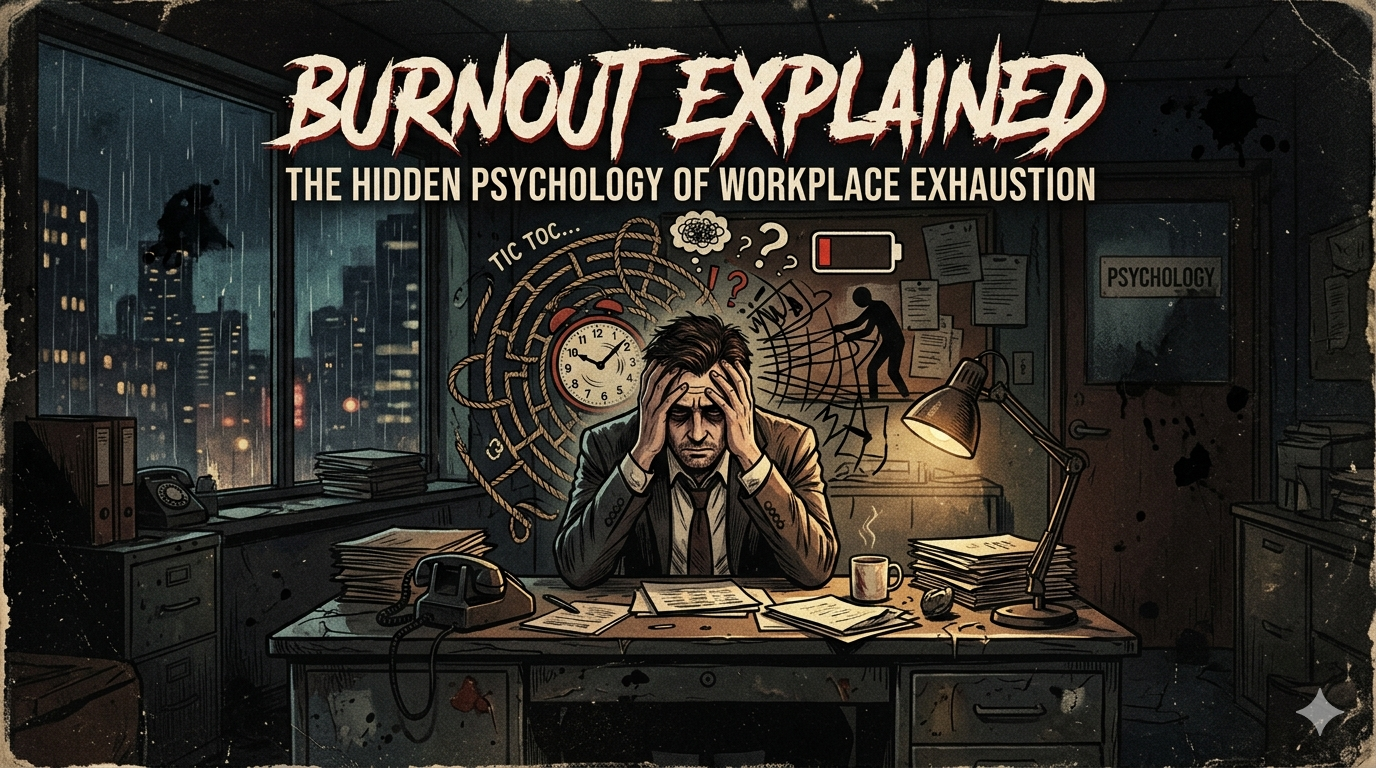

The hidden psychology of burnout is that it often grows out of traits that are socially rewarded. Conscientiousness, ambition, reliability, empathy, and perfectionism can all become risk factors in the wrong environment. The employee who always steps up, always responds, and always maintains standards is often treated as an asset right up until they start to fray.
This creates a dangerous feedback loop. The more competent you seem, the more demands come your way. The more demands you absorb, the less space you have to notice your own limits. Eventually, your nervous system stops treating work as a challenge and starts treating it as a threat.
At that point, exhaustion is not just about workload. It is about learned psychological overextension. You may feel guilty resting, uneasy when not being productive, or oddly anxious when your inbox is quiet. Many people in burnout are not only responding to external pressure. They are also responding to an internal rulebook that says worth must be earned continuously.
That is one reason burnout can feel confusing. On the surface, it looks like a work problem. Underneath, it often involves identity, boundaries, and the need for approval.
Why some jobs burn people out faster
Not all stress is equal. People can tolerate intense work surprisingly well when they have some control, clear goals, social support, and evidence that their effort matters. Burnout becomes more likely when these buffers are missing.
Low autonomy is a major factor. Humans cope better with difficulty when they feel some agency over how they respond. If your role demands constant output but gives you little control over pace, priorities, or decisions, stress starts to feel inescapable.
Unclear expectations are another problem. The brain handles challenge better than ambiguity. A hard job with defined standards is often less psychologically corrosive than a job where success keeps moving. When people do not know what counts as enough, they tend to overwork to compensate.
Then there is emotional labor – the effort involved in managing feelings as part of the job. Customer-facing roles, caregiving roles, leadership roles, and service work often require people to appear calm, warm, upbeat, or composed, regardless of what they actually feel. That gap between internal state and external performance can become deeply exhausting over time.
The myth that burnout only happens to weak or fragile people
This myth survives because burnout is still moralized. People talk about resilience as if it were a character test. But burnout is not a failure of toughness. In many cases, it is the predictable result of sustained stress in a system that rewards self-neglect.
In fact, people who burn out are often highly engaged at the start. They care deeply. They identify with their work. They want to do a good job, be useful, and maintain standards. That initial commitment is exactly what makes the eventual crash so disorienting.
The trade-off is obvious once you see it. Traits that help people succeed early can make them vulnerable later if they are paired with poor boundaries and chronic overload. Commitment becomes overcommitment. Responsibility becomes hyper-responsibility. Motivation becomes compulsion.
How burnout changes the mind

One of the most overlooked effects of burnout is cognitive narrowing. When stress becomes chronic, attention shifts toward immediate demands and perceived threats. Long-term thinking, creativity, and emotional flexibility start to shrink.
That is why burned-out people often become more reactive and less reflective. Small requests feel invasive. Minor setbacks feel personal. Decisions that once felt simple start to feel mentally expensive. This is not laziness. It is what happens when psychological bandwidth gets consumed by constant strain.
Burnout also changes emotional interpretation. Neutral events can begin to feel loaded. Feedback feels harsher. Colleagues seem more frustrating. The future looks flatter. You may still be functioning, but your internal world becomes less spacious.
This is also where cynicism enters. Cynicism is not always a personality shift. Sometimes it is a defense mechanism. If caring hurts, detachment can feel safer. The mind starts reducing emotional investment as a form of self-protection.
Why rest alone does not always fix it
A few days off can help, but recovery is rarely just about sleep. If someone returns to the same impossible workload, the same blurred boundaries, and the same internal pressure to overperform, burnout tends to restart quickly.
This is why simple advice like “take care of yourself” can feel inadequate. Self-care matters, but it cannot compensate for a workplace that chronically exceeds human limits. Nor can it fully solve the problem if the deeper pattern is psychological overidentification with achievement.
Real recovery usually involves both external and internal changes. Externally, that may mean adjusting workload, clarifying expectations, reducing constant availability, or addressing a toxic manager or team culture. Internally, it may mean challenging beliefs like “If I stop, I will fall behind” or “Being needed is what makes me valuable.”
It depends on what is driving the exhaustion. Sometimes the job is the problem. Sometimes the job is demanding but manageable, and the bigger issue is a person who cannot disengage because their self-worth is fused with performance. Often, it is both.
What actually helps when workplace exhaustion sets in
The first useful move is precision. Instead of asking, “Why am I so tired?” ask, “What kind of depletion is this?” Physical fatigue, emotional exhaustion, decision overload, resentment, boredom, and moral distress can all feel similar at first, but they point to different solutions.
The second move is to notice where your energy is leaking. For some people, the main issue is volume. For others, it is a lack of control, nonstop interruptions, role conflict, or the emotional strain of always being available. Burnout becomes easier to address when it stops being one giant foggy problem and starts becoming a pattern you can name.
The third move is boundary repair. That may sound simple, but psychologically it is often the hardest part. Boundaries are not just calendar decisions. They are identity decisions. They force you to tolerate the discomfort of not being endlessly responsive, helpful, productive, or liked.
And finally, people need recovery that actually interrupts stress physiology. Mindless scrolling after work rarely does that. Genuine recovery often looks less glamorous: sleep, movement, mentally absorbing hobbies, time with people who do not need anything from you, and periods where your brain is not bracing for the next demand.
If there is one myth worth dropping, it is the idea that burnout is just the price of being driven. It is usually a signal that something in the relationship between person, work, and identity has become unsustainable. The sooner you treat that signal as information instead of weakness, the easier it becomes to protect the part of you that works hard without letting work consume it.