
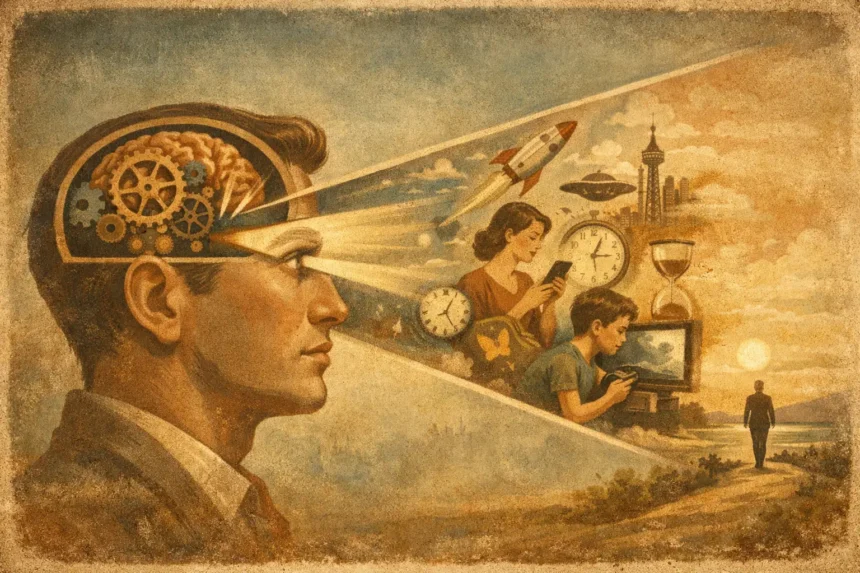
A five-second pause now feels long. A 20-minute video feels ambitious. A book can feel strangely harder to start than a thread of short posts that somehow eats 45 minutes. That shift is exactly why the future of attention span psychology matters. It is not just about whether people can still focus. It is about how attention is being trained, fragmented, protected, and monetized in real time.
A lot of the public conversation gets one thing wrong. It treats attention span as if it were a fixed personal trait, like height. You either have a good one or a bad one. Psychology says otherwise. Attention is better understood as a dynamic system shaped by motivation, stress, environment, novelty, rewards, fatigue, and meaning. That distinction matters because it changes the question from “Are our brains broken?” to “What conditions are our brains adapting to?”
Why the future of attention span psychology is not just about shorter focus
The popular story is simple: smartphones arrived, attention spans collapsed, and now nobody can concentrate. It is tidy, dramatic, and incomplete.
Research on attention does not support the idea that human beings have suddenly lost the basic capacity for sustained focus across the board. What it does suggest is more nuanced. People are becoming more practiced at task-switching, more sensitive to cues of novelty, and more vulnerable to environments that constantly interrupt goal-directed thought. In other words, the issue is not only duration. It is also an attentional style.
That matters because there is a big difference between being unable to focus and being trained to scan. Scanning is adaptive in some contexts. It helps with monitoring multiple streams of information, rapid decision-making, and spotting social or informational updates. But the trade-off is obvious. Deep reading, reflective thinking, and complex problem-solving tend to suffer when the mind is repeatedly pulled toward immediate stimulation.
So the future of attention span psychology will likely focus less on a single question like “How long can people pay attention?” and more on a better one: “What kinds of attention are being strengthened, and what kinds are being crowded out?”
Attention is becoming more context-dependent
One of the clearest directions in modern psychology is that attention is situational. People often say, “I have a terrible attention span,” when what they mean is, “I cannot focus under these conditions.” That is a different claim, and usually a more accurate one.
Someone may struggle through a dry report at work, then spend two straight hours analyzing a sports draft, editing a video, or learning a new game mechanic. This is not hypocrisy. It is a reminder that attention follows value, reward prediction, cognitive load, and emotional relevance.
Future research will probably keep moving away from blunt self-judgments and toward more precise models. Expect more emphasis on how sleep quality, chronic stress, platform design, mood, social pressure, and identity all affect attention regulation. A distracted employee, student, or partner is not always dealing with the same psychological problem. Sometimes it is overstimulation. Sometimes it is anxiety. Sometimes it is a lack of interest dressed up as a focus issue.
That is one reason simplistic claims about “shrinking attention spans” are so misleading. They flatten a highly interactive process into a moral panic.
The role of reward learning
Digital environments have become expert teachers of attentional habits. Every alert, autoplay sequence, recommendation feed, and variable reward cue nudges the brain to expect frequent updates. This is basic reward learning, not evidence of personal weakness.
Variable rewards are especially powerful because they keep attention engaged through uncertainty. You do not know whether the next swipe will be boring, funny, socially validating, or useful. That unpredictability keeps people checking. Over time, the brain becomes more responsive to rapid shifts in relevance and less tolerant of low-stimulation tasks.
The future of attention span psychology will have to take this seriously. Attention is no longer shaped only by individual discipline or educational background. It is shaped by systems designed to compete for mental priority every waking hour.
What will psychology care about next?
The next phase of this field is unlikely to obsess over average attention span in the abstract. It will care more about regulation, recovery, and control.
First, psychologists will likely focus more on attentional agency. Can a person direct attention where they want it to go, or are they mostly reacting to cues? That is a more useful marker than how long they can stare at one thing. Agency captures something modern life has made harder: choosing your focus instead of inheriting it from notifications, algorithms, and ambient stress.
Second, there will be more attention to attentional recovery. Focus is not just about exertion. It also depends on whether the mind gets space to reset. Constant partial engagement creates a strange mental residue. Even when people stop working, they do not fully disengage. That weakens restoration and makes sustained concentration harder the next day.
Third, psychology will keep distinguishing healthy adaptation from clinical impairment. Not every distracted person has ADHD. Not every attention struggle is a disorder. But greater public awareness of attention problems also has an upside: it can help people recognize when chronic impairment, emotional dysregulation, or executive dysfunction needs proper assessment rather than self-blame.
Children, work, and education will be major battlegrounds
This conversation gets especially charged around kids, but adults should not pretend they are outside the experiment. Schools, offices, and media platforms are all redesigning the ecology of attention.
In education, the challenge is not simply keeping students entertained. It is building attentional endurance without making learning dependent on constant stimulation. If every lesson has to compete with the pace of social media, education can accidentally train students to expect engagement without effort. That is a poor bargain.
At work, many jobs now reward responsiveness over concentration. Fast replies, constant availability, and meeting-heavy calendars create the appearance of productivity while quietly destroying the conditions that deep work requires. Future psychology research will likely examine how digital labor environments reshape not just focus, but identity. When people are rewarded for being perpetually reachable, distraction starts to feel like professionalism.
The real trade-off in the future of attention span psychology
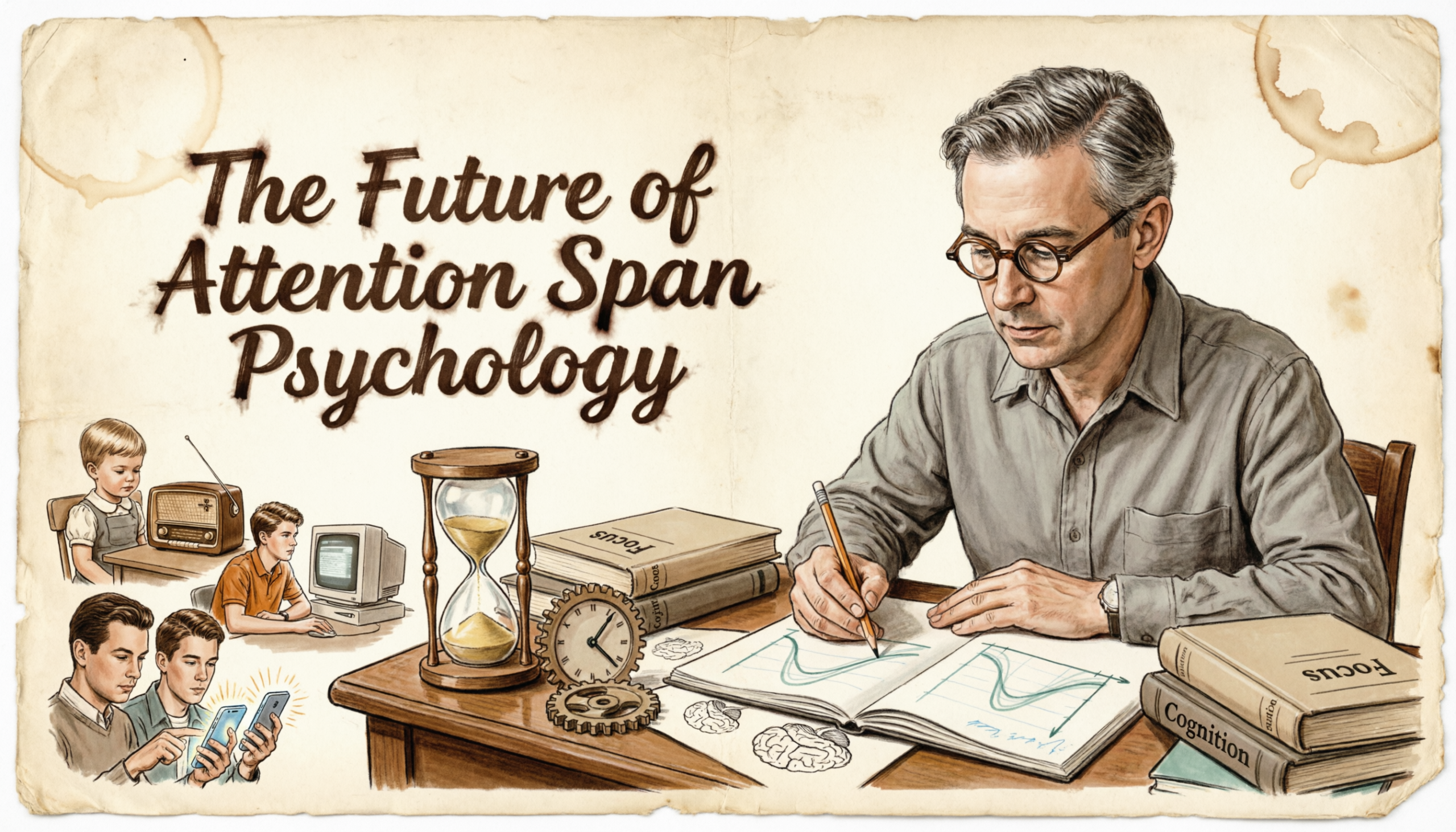
There is no honest version of this conversation that ignores trade-offs. Some modern attentional changes are useful. People can process multiple information channels more quickly than before. They can filter for relevance fast. They can learn in short bursts, adapt to changing inputs, and move fluidly across formats.
But there is a cost when speed becomes the default mode of mind. Reflection slows down. Ambiguity becomes irritating. Boredom, which often precedes creativity, gets eliminated too quickly. The brain starts preferring stimulation over substance.
That is where psychology becomes genuinely helpful. It can cut through the myths and pseudo-science by showing that attention is not a virtue contest. It is a limited resource managed by biological constraints and environmental pressures. The more aggressively an environment fragments attention, the more deliberate a person has to be to protect it.
This also means the future is not predetermined. Attention is trainable. People can rebuild tolerance for depth, but usually not through guilt or digital detox theater. More often, it happens through design. Friction matters. Boundaries matter. Single-task environments matter. So does choosing activities that produce intrinsic engagement rather than endless low-grade stimulation.
For readers of The Psychology of Everything, that is the useful lens: treat attention less like a personality flaw and more like a behavioral ecosystem. Change the cues, and attention changes with them.
What this means for everyday life
If attention becomes one of the defining psychological battlegrounds of the next decade, then the winners will not be the people with perfect self-control. They will be the people who understand what attention actually responds to.
That means noticing when you are mentally depleted rather than assuming you are lazy. It means seeing boredom not as failure, but as a threshold that deeper focus often requires. It means recognizing that fragmented attention can mimic anxiety, and anxiety can mimic an attention problem. It also means admitting that some technologies are not neutral tools. They are active participants in shaping how your mind allocates value.
The bigger shift may be cultural. We may start treating attention as a health issue, a workplace issue, a learning issue, and a relationship issue all at once. Because it is all of those. If your attention is constantly elsewhere, your decisions get worse, your conversations get thinner, your work becomes shallower, and your inner life gets noisier.
The future of attention span psychology will not be about proving that humanity has become incapable of focus. It will be about understanding which environments produce scattered minds, which habits rebuild cognitive stamina, and who benefits when attention stays unstable.
That is a better question than whether people can still pay attention. It asks something sharper: what is competing for your mind, and what kind of person does that competition gradually train you to become?