



- Why do people self-sabotage in the first place?
- Self-sabotage is usually self-protection in disguise
- The hidden drivers behind self-defeating behavior
- Fear of identity change
- Low self-worth and expectation management
- Learned patterns from early experience
- Cognitive dissonance and internal conflict
- What self-sabotage actually looks like
- How to stop self-sabotage without turning it into self-war
- Why self-compassion works better than shame
You finally get momentum – then miss the deadline, pick a fight, skip the workout, ignore the text, or talk yourself out of the opportunity you wanted a week ago. From the outside, it looks irrational. From the inside, it often feels weirdly familiar.
That familiarity is the key!
When people ask, why do people self-sabotage, they usually imagine a character flaw: low discipline, laziness, lack of willpower, maybe even a secret desire to fail. Psychology points somewhere more interesting. Self-sabotage is often an attempt at protection. It can be clumsy, costly, and self-defeating, but it usually serves a purpose in the moment.
The mistake is assuming that if a behaviour hurts your long-term goals, it must make no sense. In human behaviour, short-term relief often beats long-term benefit. That is where self-sabotage lives.
Why do people self-sabotage in the first place?
At its core, self-sabotage happens when one part of you wants change and another part sees change as a threat.
That threat is not always dramatic. Sometimes it is the fear of failure. Sometimes it is fear of success and the pressure that comes with it. Sometimes it is exposure, disappointment, rejection, shame, or the loss of an identity that has become strangely comfortable. The mind not only protects us from danger. It also protects us from uncertainty, and growth is full of uncertainty.
This is why people can deeply want something and still behave against their own interests. A promotion might bring status, but also scrutiny. A healthy relationship might bring love, but also vulnerability. Finishing a creative project might bring pride, but also judgment. If your nervous system has learned that visibility, closeness, or risk come with pain, self-sabotage can become a strategy for staying in known territory.

It is not a good strategy. But it is often understandable.
Self-sabotage is usually self-protection in disguise
A lot of popular advice treats self-sabotage as a problem of motivation. Just want it more. Just be more consistent. Just stop making excuses. That framing can be useful when avoidance is mild, but it misses the psychology underneath.
People often sabotage themselves because the alternative feels emotionally expensive. Procrastination can protect you from the possibility of trying hard and still falling short. Perfectionism can protect you from criticism by making completion impossible. Picking unavailable partners can protect you from true intimacy. Quitting early can protect you from being tested.
Notice the pattern: the behavior reduces emotional discomfort now, even if it creates practical problems later.
This is also why self-sabotage can feel compulsive. You are not always choosing between success and failure. You are often choosing between discomfort now and discomfort later. Most brains are biased toward immediate relief.
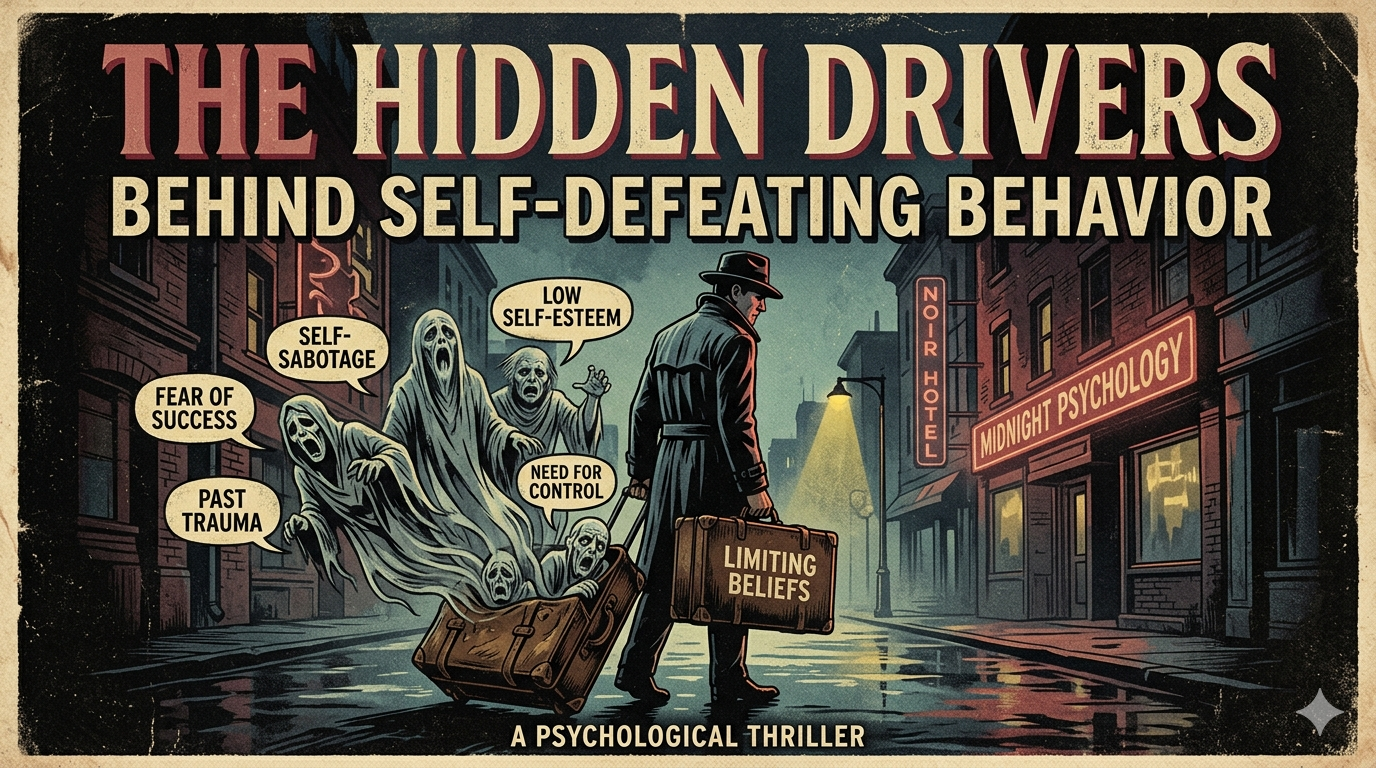
The hidden drivers behind self-defeating behavior
Fear of identity change
People like to think they want a better life. More often, they want a better life that still feels like them.
The problem is that meaningful change can destabilize identity. If you have spent years being the underachiever, the helper, the anxious one, the funny one, or the person who never really commits, success can create a strange kind of disorientation. Who are you if you become disciplined, visible, confident, or successful? That question sounds abstract, but it shapes behavior more than most people realize.
Humans are strongly motivated to stay coherent with their self-concept. If achievement threatens that coherence, sabotage can pull you back into a familiar story.
Low self-worth and expectation management
Some people sabotage because they do not believe good outcomes are sustainable for them. If you expect rejection, success, love, or stability can feel temporary at best and suspicious at worst.
In that context, self-sabotage can work like expectation management. If things fall apart because you caused it, that can feel easier than waiting to be disappointed by someone else or by life itself. Pain you control can feel safer than pain you do not.
This is one reason people sometimes create the very outcomes they fear. It is not because they want them. It is because predictability can feel safer than hope.
Learned patterns from early experience
Many self-sabotaging patterns are learned adaptations. If you grew up in an environment where mistakes led to humiliation, visibility might still feel dangerous. If affection was inconsistent, you may confuse emotional unpredictability with chemistry. If achievement was tied to pressure or criticism, success might carry a hidden emotional cost.
These patterns are not destiny, but they do shape the defaults your brain returns to under stress.
Psychology is full of behaviors that make sense in one environment and become costly in another. Self-sabotage often belongs in that category.
Cognitive dissonance and internal conflict
People can hold conflicting beliefs at the same time. You might believe you are capable, and also believe you are not the kind of person who follows through. You might want intimacy and also associate closeness with danger. You might want success and also resent what success seems to require.
When beliefs clash, behavior often resolves the conflict before conscious reasoning does. That is why people can sincerely set goals and repeatedly fall short of them. The problem is not always dishonesty. Sometimes it is an internal contradiction.
What self-sabotage actually looks like
Self-sabotage is not always dramatic. Sometimes it looks almost respectable.
It can look like overthinking until the opportunity passes. It can look like endlessly researching instead of deciding. It can look like staying “busy” with low-stakes tasks while avoiding the one action that would move your life forward. It can look like chasing perfection, choosing the wrong people, numbing out, missing small commitments, or starting strong and disappearing when progress becomes visible.
This is why self-sabotage is easy to miss. It often wears the costume of caution, standards, independence, realism, or spontaneity.
That does not mean every delay or change of mind is sabotage. Sometimes a goal is wrong for you. Sometimes burnout is real. Sometimes your reluctance is wisdom. The difference is in the pattern. If the same emotional logic keeps derailing things that matter to you, it is worth paying attention.
How to stop self-sabotage without turning it into self-war

The most effective response is not harsher self-criticism. If self-sabotage is partly a protection strategy, attacking yourself usually strengthens the threat response.
Start by asking a better question. Not “What is wrong with me?” but “What is this behavior trying to protect me from?” That shift matters. It moves you from moral judgment to psychological investigation.
Once you identify the threat, make it smaller and more specific. A lot of sabotage comes from treating action like an identity referendum. If one email becomes proof of your worth, of course, your nervous system resists it. Reduce the meaning. Send the email. Do not turn it into a verdict on your future.
It also helps to focus on tolerating discomfort rather than waiting for confidence. Confidence is often the reward for action, not the prerequisite. People who stop self-sabotaging are not necessarily fearless. They get better at feeling exposed without retreating.
Practical design matters too. If you only rely on insight, you will miss the behavioral side of the problem. Shorten the gap between intention and action. Remove friction. Use deadlines, smaller commitments, visible tracking, or accountability with someone calm rather than shaming. Structure cannot solve every emotional conflict, but it can reduce the opportunities for avoidance to take over.
And if the pattern is deep, recurring, and tied to trauma, attachment wounds, or persistent anxiety, this is where therapy can be more than helpful. It can help you update old predictions that your mind still treats as facts.
Why self-compassion works better than shame
This is the part people often resist. Self-compassion sounds soft, and self-sabotage feels like a problem that needs firmness.
But shame tends to narrow attention, increase avoidance, and confirm the very beliefs that feed sabotage in the first place. If every mistake becomes evidence that you are flawed, your brain will keep choosing protective behaviors over vulnerable ones.
Self-compassion is not letting yourself off the hook. It is refusing to add unnecessary threat to a system that is already reacting to a threat. That makes change more likely, not less.
At The Psychology of Everything, the useful question is rarely whether a behavior is good or bad. It is what function it serves, what belief it protects, and whether that pattern still fits the life you want now.
If you keep getting in your own way, assume there is logic there before you assume there is weakness. People do not usually sabotage themselves because they are broken. They do it because some part of them learned that staying small, hidden, distracted, or in control was safer than moving forward. Once you see that clearly, change stops being a battle against yourself and starts becoming a negotiation with an older survival strategy that may no longer be needed.