



Some mornings, your goals feel obvious. You want the workout, the writing session, the budget reset, the hard conversation. Other mornings, the exact same goal feels weirdly far away, as if a different version of you made the plan. That gap is where motivation vs discipline psychology gets interesting – and where most self-help advice starts to fall apart.
The popular story is simple: motivation gets you started, discipline keeps you going. That sounds neat, but psychology paints a more complicated picture. Motivation is not just a burst of inspiration, and discipline is not just gritting your teeth. Both are shaped by emotion, reward, identity, context, and the design of your environment. If you treat them like personality traits, you miss the part that actually helps: behavior is more situational and trainable than people think.
What motivation vs discipline psychology actually looks at
Psychologically, motivation is about the forces that energize and direct behavior. Those forces can be internal, like curiosity or personal meaning, or external, like money, deadlines, approval, or fear of consequences. Discipline, by contrast, is less a separate force and more a pattern of self-regulation: the ability to act in line with a goal even when your immediate mood points elsewhere.
That distinction matters because motivation is often emotion-sensitive. It rises when a goal feels rewarding, urgent, socially meaningful, or tied to your identity. It drops when the reward feels distant, the task feels ambiguous, or stress narrows your focus to immediate comfort. Discipline is what helps bridge that gap, but even discipline is not endless. It works better when the task is clear, the friction is low, and the behavior has become familiar.
In other words, discipline is not the heroic opposite of motivation. It is usually motivation that has been structured well.
Why motivation feels powerful but unreliable
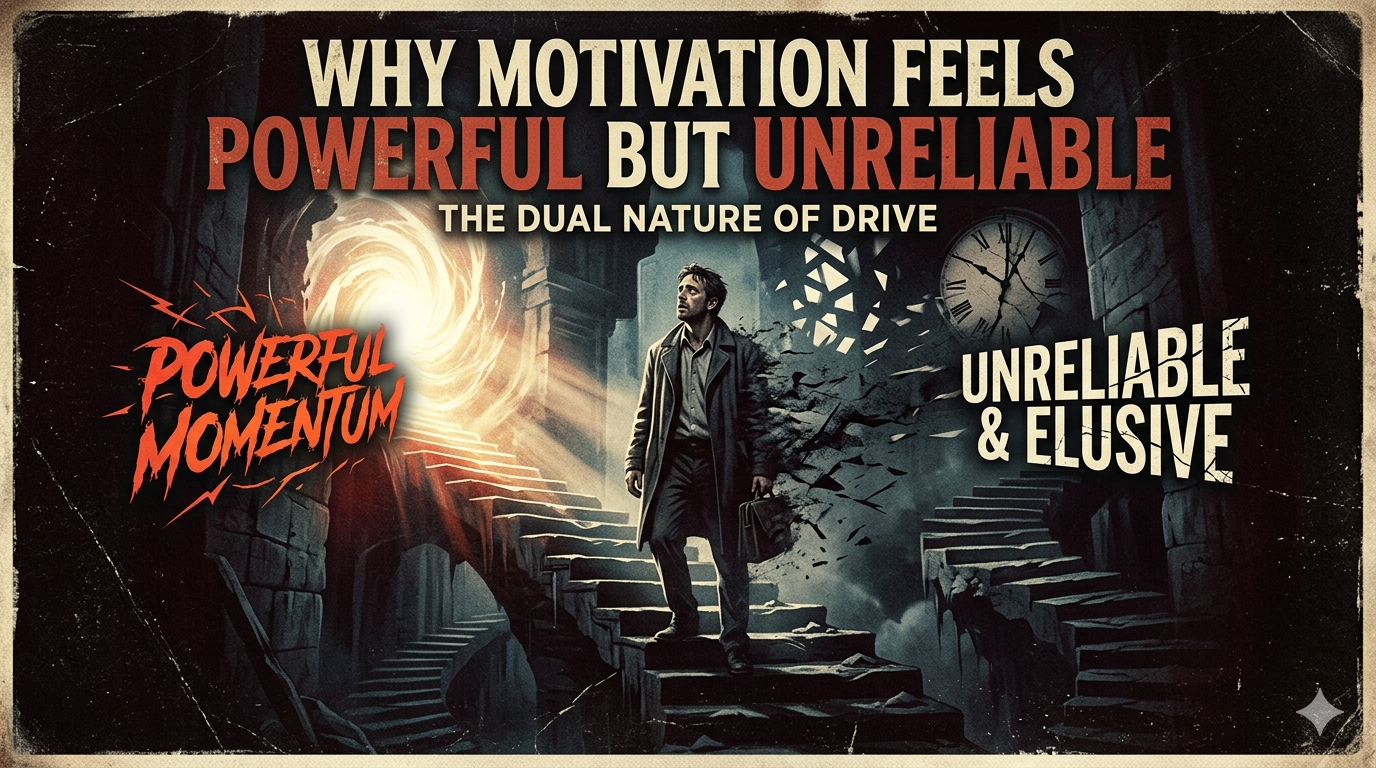

Motivation gets overrated because it is vivid. You feel it. It creates momentum, emotional certainty, and the sense that change is finally happening. That early rush can be useful, especially at the start of a new habit, project, or identity shift.
The problem is that motivation is highly responsive to context. Sleep loss, stress, uncertainty, social comparison, low mood, and decision fatigue can all reduce the appeal of effortful tasks. The brain is not asking, “What matters most in theory?” It is constantly asking, “What feels worth doing right now?”
This is one reason delayed rewards are so psychologically difficult. A workout promises future fitness, not instant pleasure. Saving money promises future security, not the hit of buying something today. Studying promises future competence, not immediate excitement. Motivation struggles when the benefit is abstract, and the cost is immediate.
Researchers often describe this as present bias. We overweight what we can feel now and discount what arrives later. That does not make you lazy. It makes you human.
Why discipline is less glamorous and more useful
Discipline tends to look boring from the outside because it relies less on emotional intensity and more on behavioral consistency. People often imagine disciplined individuals as unusually strong-willed, but that is only part of the story. In many cases, disciplined people are simply better at reducing the number of moments where willpower is needed.
They make the good choice easier, more automatic, or more expected. They put the phone in another room. They work at the same time each day. They prepare in advance. They create deadlines. They attach actions to existing routines. They do not rely on feeling ready.
This aligns with what psychology has shown for years: repeated behavior in stable contexts becomes more automatic over time. Habit formation reduces the need for active self-control. So when people say discipline beats motivation, what they often mean is this: systems beat moods.
That said, discipline has limits too. If your life is chaotic, your stress is chronic, or your goal is poorly matched to your actual values, discipline can start to feel like constant internal combat. That usually does not produce sustainable change. It produces burnout, avoidance, or guilt.
The hidden driver: identity
One of the most useful ideas in motivation vs discipline psychology is that both become stronger when behavior feels identity-consistent.
People persist more easily when an action supports the kind of person they believe they are, or want to become. If you are trying to run because you hate your body, motivation may be unstable, and discipline may feel punitive. If you are running because you see yourself as someone who takes care of their mental and physical state, the same action carries less internal resistance.
Identity does not remove effort. It changes the meaning of effort. That shift matters because the brain is not only tracking reward. It is also tracking self-coherence. We are strongly motivated to behave in ways that feel consistent with our self-concept.
This is why tiny repeated actions matter more than dramatic declarations. You do not become disciplined by saying, “I need more discipline.” You become disciplined by accumulating evidence that you are a person who follows through.
Motivation vs discipline psychology in everyday life

Consider someone trying to build a reading habit. If they wait to feel inspired every night, the habit will be fragile. If they force themselves through an hour of difficult reading when exhausted, they may start associating reading with strain. A better psychological approach is to lower the activation energy: keep a book visible, set a tiny target, attach reading to an existing cue like tea before bed, and choose material that feels genuinely rewarding.
That is not a trick. It is behavior design. And it reflects a broader truth: the most effective form of discipline often looks like an intelligent setup.
The same principle applies to exercise, focused work, spending, sleep, and even relationships. People usually fail not because they lack values, but because the environment keeps rewarding the wrong behavior at the wrong time. Notifications reward distraction. Convenience rewards impulse spending. Fatigue rewards avoidance. Discipline becomes much easier when those incentives are made visible.
So which matters more?
If the question is what starts the change, motivation often matters more. If the question is what sustains change, discipline usually matters more. But that still oversimplifies the psychology.
Early motivation helps people commit, imagine a different future, and take the first uncomfortable steps. Discipline helps them keep acting when novelty fades. Over time, though, the strongest driver is neither raw motivation nor brute discipline. It is the transition from effortful self-control to stable routine.
That transition is where many people get stuck. They keep treating every day as a fresh test of character instead of building repeatable conditions that make the desired behavior easier.
A useful way to think about it is this: motivation is your spark, discipline is your bridge, and habit is your infrastructure.
How to use the psychology instead of fighting it
If your motivation is inconsistent, the answer is not to shame yourself for it. It is to work with how behavior actually operates.
Start by making goals concrete. The brain handles “walk for ten minutes after lunch” far better than “get healthier.” Specific actions reduce ambiguity, and ambiguity quietly drains follow-through.
Next, shorten the distance to the reward. If a behavior only pays off in six months, motivation will keep dropping. Add immediate rewards that do not cancel the goal: tracking progress, pairing the task with music, using social accountability, or noticing the instant mental benefit rather than only the long-term outcome.
It also helps to reduce friction aggressively. The more decisions, preparation, and inconvenience a behavior requires, the more room there is for avoidance. People often frame this as laziness, but friction is a serious psychological force. A task that is 20 percent easier can get done 200 percent more often.
Finally, watch your self-talk. If every lapse becomes proof that you are undisciplined, you create an identity that works against future effort. A more accurate frame is behavioral, not moral: what condition made the action harder, and what setup would make it easier next time?
That is one of the clearest ways to cut through the myths and pseudo-science around self-control. Lasting behavior change rarely comes from becoming a tougher person. It comes from becoming a more perceptive one.
The most useful closing thought is this: stop asking whether you need more motivation or more discipline. Ask what makes the right action easier to repeat when your feelings change. That question is less dramatic, but it is far closer to how real change happens.