

- Why the myth of the true self feels so convincing
- What psychology says about the self
- The trouble with authenticity culture
- The myth of the true self can keep people stuck
- A better model: the self as something you build
- How to think about identity without the fantasy
- What authenticity is actually worth keeping
A lot of people carry a quiet suspicion that somewhere underneath the mess of daily life, social roles, and mixed motives, there is a single real version of them waiting to be uncovered. That idea sits at the center of the myth of the true self – and it is one of the most seductive stories modern culture tells about identity.
It shows up everywhere. In breakup advice that says you need to “find yourself.” In career panic, that frames the wrong job as a betrayal of who you really are. In self-help language that treats confusion as proof you have drifted away from your authentic core. The appeal is obvious. If there is one hidden, stable self beneath all the noise, then life’s job is simply to locate it and live from there.
Psychology gives us a less flattering, but more useful, picture. We are not usually uncovering a fixed self. We are interpreting ourselves, revising ourselves, and in many cases actively constructing who we become.
Why the myth of the true self feels so convincing
The myth persists because it solves several emotional problems at once. It offers coherence in a life that often feels fragmented. Most people behave differently at work, with friends, with family, and when they are alone. A hidden “real me” seems to tie those versions together.
It also protects self-esteem. If you make choices you regret, the true-self idea lets you separate your mistakes from your identity. That was not the real you. The real you is still good, still intact, still waiting underneath the bad decision, the bad relationship, or the bad year.
There is also a strong cultural force behind it. Western culture especially tends to treat authenticity as a moral ideal. We praise people for being true to themselves and judge them harshly when they seem fake, performative, or easily influenced. That makes identity feel like a discovery project rather than an adaptive process.
But psychologically, that is too neat.
What psychology says about the self
The self is not one thing. It is a set of processes.
Research across personality, social psychology, and cognitive science suggests identity is made up of habits, memories, values, roles, self-stories, and social feedback. Some traits are relatively stable over time, but how you understand and express yourself shifts with experience and context. You are not a fraud because different environments bring out different sides of you. That is normal human behavior.
Social psychologists have long shown that behavior is shaped by situation more than people like to admit. You may think your “real self” is calm, generous, and principled, until you are sleep-deprived, threatened, embarrassed, or trying to fit in. Context does not always reveal a false self. Often, it reveals that personality is conditional.

Memory makes this even more complicated. People do not simply access an objective archive of who they are. We reconstruct memory. We emphasize certain turning points, forget contradictory evidence, and build narratives that make our lives feel consistent. That story can be meaningful, but it is still a story.
This matters because many people confuse a compelling self-narrative with psychological truth.
The trouble with authenticity culture
The modern obsession with authenticity sounds healthy, but it often smuggles in a misleading assumption: that your best decisions come from turning inward and consulting your deepest essence.
Sometimes that works. If you have spent years people-pleasing or suppressing your preferences, paying attention to your own reactions can be corrective. But “be yourself” is not universally good advice. What if your current impulses are immature, avoidant, or shaped by old defenses? What if your “authentic” pattern in relationships is jealousy? What if the most natural version of you procrastinates, shuts down, or seeks status at any cost?
A lot of growth requires doing things that do not initially feel natural. Boundaries can feel unnatural to someone raised to appease others. Honest communication can feel unnatural to someone used to conflict avoidance. Exercise, discipline, and emotional regulation often feel less like self-expression and more like training.
That does not make them fake. It makes them developmental.
The myth of the true self can keep people stuck
One of the biggest problems with the true-self idea is that it can turn change into betrayal. If you believe there is one essential you, then evolving too much may feel inauthentic.
People stay in old identities for this reason. The “creative one” resists structure because it seems too conventional. The “nice one” avoids assertiveness because it feels harsh. The “independent one” struggles to ask for help because dependence clashes with the self-image. In each case, identity becomes a cage disguised as honesty.
This is where the myth becomes expensive. It can keep you loyal to outdated traits, roles, and stories long after they stop serving you.
There is also a moral bias built into how people think about the true self. Studies have found that people often assume a person’s true self is morally good, even when that person behaves badly. In other words, we do not just imagine a deeper self – we imagine a better one. That can be comforting, but it also lets people excuse recurring patterns they need to face more directly.
If someone repeatedly lies, cheats, or manipulates, saying “that is not who they really are” may reflect hope more than insight.
A better model: the self as something you build
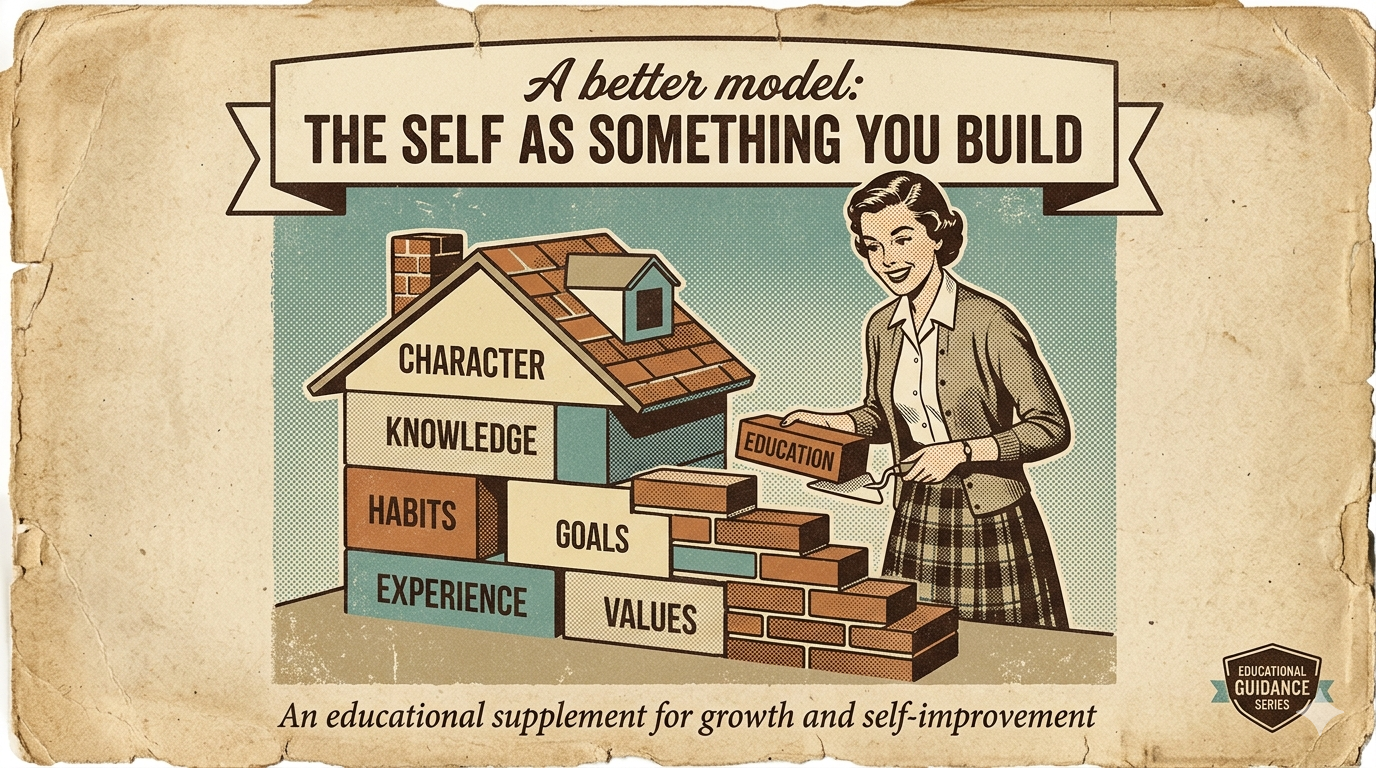
A more psychologically grounded way to think about identity is this: you are not uncovering a single true self. You are building a self through repeated choices, social experiences, and interpretation.
That does not mean identity is fake or infinitely flexible. Biology matters. Temperament matters. Early attachment matters. Personality differences are real. Some patterns will come more naturally to you than others.
But within those constraints, people are remarkably shapeable. Values can be clarified. Habits can be trained. Emotional reactions can be understood and regulated. Roles can expand. New experiences can pull forward parts of you that had little chance to develop earlier.
This is a less romantic view than “find your true self,” but it is more empowering. If identity is partly constructed, then you are not waiting for self-knowledge to arrive before life can begin. You can participate in becoming.
How to think about identity without the fantasy
A healthier question is not “Who am I really?” but “What kind of person am I practicing being?” That shift matters.
It moves attention away from hidden essence and toward patterns. How do you act under pressure? What do you reinforce with repetition? Which environments make you sharper, kinder, and more stable? Which ones bring out pettiness, numbness, or self-abandonment?
It also forces more honesty about trade-offs. No version of you can maximize freedom, closeness, status, security, spontaneity, and peace at the same time. Any identity you build will prioritize some values over others. That is not evidence that you have missed your true self. It is what adult life looks like.
You can also stop treating inconsistency as failure. Humans contain contradictions because life makes contradictory demands. You can be confident at work and insecure in love. Generous with friends and defensive with family. Deeply self-aware and still vulnerable to the same old triggers. The goal is not total inner purity. It is greater coherence and less self-deception.
For readers who want psychology to be useful, this is the key distinction. Self-understanding is not about finding a hidden core that will make every decision obvious. It is about seeing your patterns clearly enough to shape them with intention.
What authenticity is actually worth keeping
The word authenticity does not need to be thrown out completely. It just needs a better definition.
Authenticity is not perfect alignment with some buried essence. It is a workable fit between your values, your behavior, and the story you tell about your life. That fit will never be complete. It changes as you change. Sometimes growth means expressing who you already are more honestly. Sometimes it means becoming someone your past self would barely recognize.
Both can be real.
That is the useful correction to the myth. You do not have one pristine self hidden underneath performance, adaptation, and contradiction. You have capacities, tendencies, blind spots, and choices. You have a past that shaped you and a future that still depends on what you rehearse now.
If that feels less comforting than the fantasy of a fixed inner truth, it is also more liberating. You are not failing because you have not located the one real you. You are doing what humans do – assembling identity in real time, under pressure, with incomplete information, and with more room to change than you may think.
A better life usually starts there: not with self-discovery as excavation, but with self-creation as an honest practice.