
- What evolutionary psychology basics actually mean
- The big idea: your mind solves recurring problems
- Why attraction and jealousy get so much attention
- Why cooperation matters just as much as competition
- What evolutionary psychology gets right
- Where evolutionary psychology basics go wrong
- How to think about the field without getting fooled
- Why evolutionary psychology basics still matter
You can learn a lot about modern life from a Stone Age brain – but only if you’re careful not to turn that idea into a lazy just-so story. That tension is the heart of evolutionary psychology basics: the field tries to explain parts of human behavior by asking what kinds of psychological tendencies may have helped our ancestors survive and reproduce. It’s a powerful lens, but not a free pass to explain everything with cavemen and mating instincts.
What makes the topic so compelling is that it touches questions people already care about. Why are we so sensitive to status? Why does social rejection sting so much? Why are jealousy, attraction, tribalism, and parenting emotions so intense? Evolutionary psychology offers one set of answers. The best versions are grounded in evidence and modest about what we can know. The worst versions flatten human complexity into catchy myths.
What evolutionary psychology basics actually mean
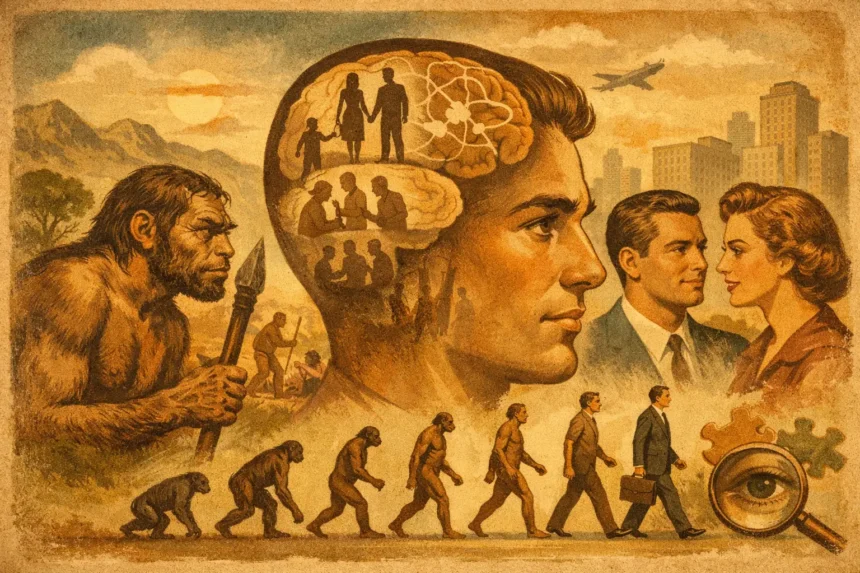
At its core, evolutionary psychology starts from a simple claim: the human mind was shaped by natural selection, just like the human body. If physical traits can evolve because they solve recurring problems, then psychological tendencies might also evolve for the same reason.
That does not mean every behavior is an adaptation. It means some mental systems may have developed because they improved ancestral odds of survival or reproduction. Think threat detection, social bonding, disgust, mate preferences, jealousy, kin care, coalition-building, and fairness tracking. These are not conscious strategies that people sit down and choose. They are tendencies, sensitivities, and biases that may have been useful often enough to stick around.
This is where people get tripped up. Evolutionary psychology is not saying humans are trapped by biology, or that culture does not matter, or that whatever exists today is natural and therefore good. It is trying to explain why certain psychological patterns show up so reliably across people and contexts.
The big idea: your mind solves recurring problems
One of the field’s central assumptions is that our ancestors faced recurring challenges. They had to avoid predators, choose allies, find mates, detect cheating, care for children, and navigate social rank. Over time, minds that handled those problems better would have had an edge.

So instead of picturing the brain as a general-purpose blank slate, evolutionary psychologists often describe it as a collection of specialized systems. One system may be highly alert to social exclusion. Another may track fairness in exchanges. Another may respond strongly to contamination cues, which helps explain disgust.
This does not mean the brain is a neat toolbox with labeled compartments. Real brains are messy, flexible, and shaped by development. But the broader idea matters: some of our reactions may make more sense when you ask what problem they might have solved in ancestral environments.
That is one reason social pain feels so real. In a small interdependent group, being excluded was not just emotionally unpleasant. It could be dangerous. The same logic may help explain why public embarrassment, betrayal, or loss of status can trigger outsized reactions in modern settings, even when physical survival is not on the line.
Why attraction and jealousy get so much attention
A lot of popular interest in evolutionary psychology centers on sex and relationships. That is partly because mating and parenting are central to evolutionary theory, and partly because these topics generate strong opinions fast.
The basic argument is straightforward. If men and women faced somewhat different reproductive pressures over evolutionary time, they may have evolved somewhat different average tendencies in mate preferences and jealousy triggers. For example, researchers have proposed that men may be more sensitive, on average, to cues of sexual infidelity, while women may be more sensitive, on average, to emotional infidelity or resource diversion.
This is where nuance matters. Average tendencies are not rigid rules. Individuals vary enormously. Sexual orientation, personality, attachment style, culture, life stage, and social norms all shape what people want and fear in relationships. A statistical tendency is not a script for your own life.
The same goes for attraction. Evolutionary accounts often focus on signals that may have historically hinted at health, fertility, competence, protection, or investment. But modern attraction is filtered through media, values, subcultures, technology, and personal history. Biology may load the gun, but context often aims it.
Why cooperation matters just as much as competition
A common misconception is that evolutionary psychology reduces humans to selfish gene machines. That misses half the picture. Humans are also unusually cooperative. We form friendships, care for relatives, punish cheaters, share knowledge, and build moral systems.
From an evolutionary perspective, cooperation can make sense. Helping genetic relatives may support shared genes. Reciprocal cooperation can pay off when people help each other over time. Reputation also matters. In social groups, generous or trustworthy behavior can improve status, alliances, and future support.
This helps explain why unfairness can feel so provocative. People are often willing to sacrifice personal gain to punish cheaters or freeloaders. That is not irrational if your ancestors lived in small groups where unchecked exploitation could spread quickly.
It also helps explain why gossip is so hard to resist. Gossip is not always petty entertainment. It can function as social information – a way of tracking who is reliable, who broke norms, and who might threaten group trust.
What evolutionary psychology gets right
At its best, the field does something incredibly useful: it forces us to ask deeper questions about function, not just surface behavior. Instead of stopping at what people do, it asks why a tendency might exist in the first place.
That can sharpen our thinking about fear, disgust, parenting, friendship, envy, and moral judgment. It can also push back against the comforting myth that humans are endlessly malleable. We are adaptable, yes, but not infinitely programmable. Some emotional reactions are ancient, fast, and deeply patterned.
This perspective can also be practical. If you know the mind is biased toward immediate rewards, status comparison, novelty, and social approval, a lot of modern struggles start to look less mysterious. Doomscrolling, junk food cravings, outrage cycles, and status anxiety are not proof that humans are broken. They may reflect old motivational systems colliding with environments they were not built for.
Where evolutionary psychology basics go wrong
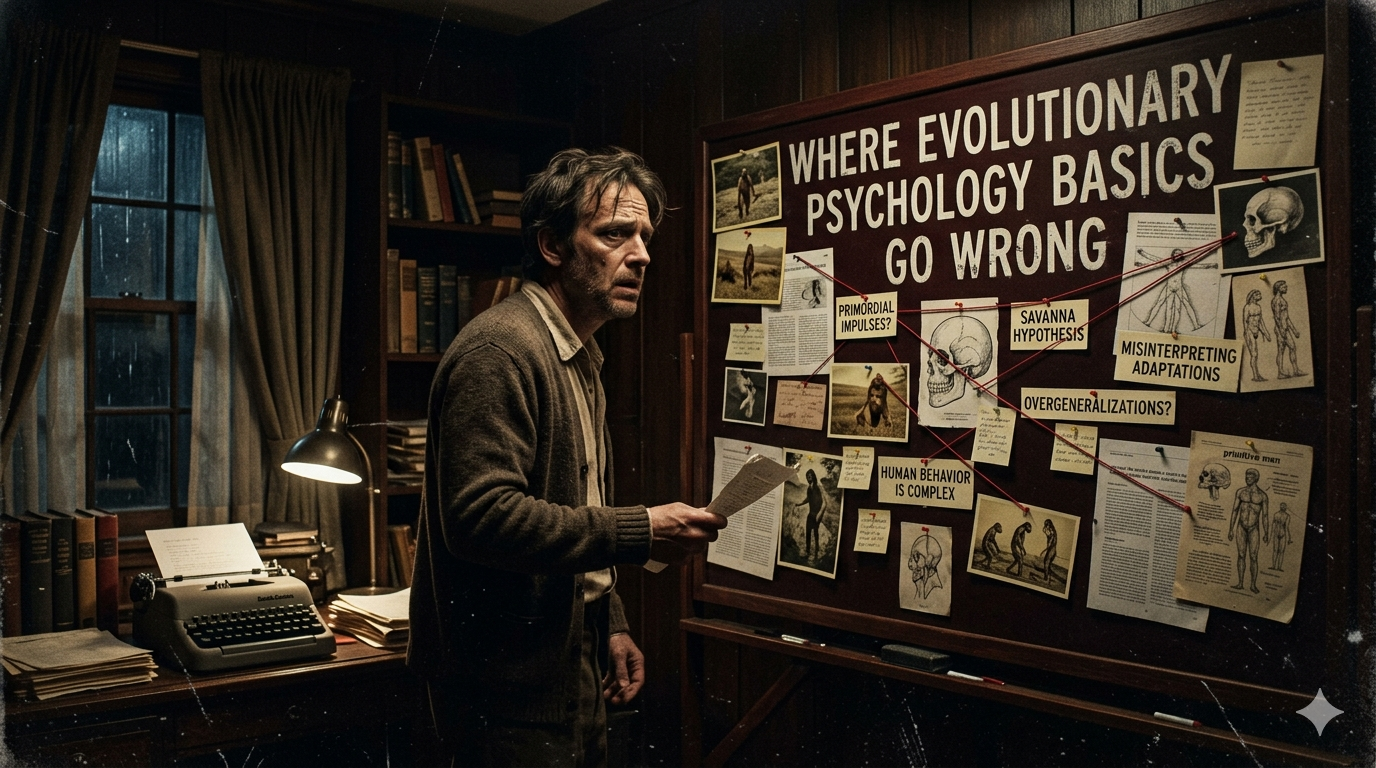
Now for the reality check. Evolutionary psychology is easy to misuse because evolutionary explanations can sound plausible even when the evidence is thin.
The classic problem is the just-so story: a neat tale about why a behavior evolved, offered with confidence but little proof. Humans are great storytellers. That does not mean every elegant explanation is scientifically solid.
Another problem is treating current behavior as a direct window into ancestral function. A behavior might be a byproduct rather than an adaptation. It might emerge from general learning mechanisms. It might reflect culture more than evolved design. Or several explanations may be true at once.
There is also a moral risk. People sometimes smuggle in the idea that if a trait is evolved, it is inevitable, acceptable, or beyond critique. That is bad reasoning. Natural does not mean good. Aggression, jealousy, favoritism, and prejudice may have roots in evolved psychology, but that tells us nothing about whether we should endorse them.
How to think about the field without getting fooled
The smartest way to use evolutionary psychology is as a framework, not a shortcut. Good questions to ask are: Is there strong cross-cultural evidence? Are there competing explanations? Does the claim rely on stereotypes? Is it describing an average tendency or pretending to explain everyone? Does it confuse what might have been adaptive in the past with what is healthy now?
You also want intellectual humility. We cannot run experiments on the ancestral past. Researchers infer likely pressures from present data, comparative biology, archaeology, and cross-cultural patterns. Sometimes the case is strong. Sometimes it is suggestive. Sometimes it is mostly guesswork dressed up as certainty.
That is why the most credible voices in this space do not use evolution to flatten people into caricatures. They use it to add one layer of explanation alongside neuroscience, developmental psychology, learning theory, and culture.
Why evolutionary psychology basics still matter
If you want to understand modern behavior, it helps to know that human beings did not arrive in the smartphone era with a fresh operating system. We brought ancient priorities into a radically new environment. We are still sensitive to threat, belonging, mate value, status, and fairness, even when those pressures now show up through office politics, dating apps, comment sections, and group chats.
That lens can make you more perceptive, not more cynical. It can help you notice when your instincts are useful and when they are misfiring. It can help you see that some of your strongest reactions are not random character flaws but old psychological machinery doing its best in unfamiliar conditions.
The real value of evolutionary psychology basics is not that they explain everything. They do not. It is that they give you a sharper starting point for asking better questions about human nature, including your own. And once you start seeing behavior through that lens, you become a little harder to fool – by cultural myths, by pseudo-science, and sometimes by your own first impressions.