
- What dopamine actually does to your brain
- Dopamine is a motivation and learning signal, not just a reward signal
- Why dopamine gets confused with pleasure
- What dopamine actually does to your brain when habits form
- Dopamine and attention: why some things suddenly feel urgent
- Low dopamine is not a personality flaw
- The myth of the dopamine detox
- So what should you do with this knowledge?
You can blame dopamine for a lot of things people casually call an “addiction” – your phone checking, your late-night scrolling, your sudden urge to refresh your inbox again. But if you want to understand what dopamine actually does to your brain, the popular story is too simple to be useful. Dopamine is not the brain’s pleasure chemical in any neat, one-line sense. It is far more interesting than that, and far more relevant to how you make decisions every day.
What dopamine actually does to your brain
At its core, dopamine helps your brain decide what matters enough to pursue, repeat, or learn from. It is deeply involved in motivation, reinforcement, attention, movement, and prediction. That means dopamine is less about giving you pleasure and more about helping your brain tag certain experiences, cues, and actions as worth noticing.
This is why the “dopamine hit” explanation often misses the point. If dopamine were simply pleasure in chemical form, then it would rise only when something feels good. But research has shown that dopamine neurons often fire in response to anticipation, novelty, and unexpected rewards. Your brain is not just reacting to what feels good in the moment. It is constantly trying to predict what is about to matter.
That distinction changes everything. Dopamine is part of the system that nudges you toward the future, not just the molecule that rewards you for the past.
Dopamine is a motivation and learning signal, not just a reward signal
One of the most useful ways to think about dopamine is as a teaching signal. When something turns out better than expected, dopamine activity can increase. When it turns out worse than expected, that activity can drop. This helps the brain update its model of the world.
Psychologists and neuroscientists often talk about this in terms of reward prediction error. The phrase sounds technical, but the idea is intuitive. Your brain is always making guesses. Was that notification worth checking? Is this person likely to text back? Will this extra effort pay off? Dopamine helps track the gap between what you expected and what actually happened.
When the outcome beats your expectation, your brain takes note. The cue that came before it becomes more meaningful. That is how habits strengthen. It is also how your environment starts shaping your behavior in ways you barely notice.
A good example is social media. It is not rewarding only because seeing a like or message feels good. It is sticky because the reward is variable and unpredictable. Sometimes there is something exciting waiting. Sometimes there is not. That uncertainty can keep dopamine systems highly engaged, because the brain is paying attention to the possibility of payoff.
Why dopamine gets confused with pleasure
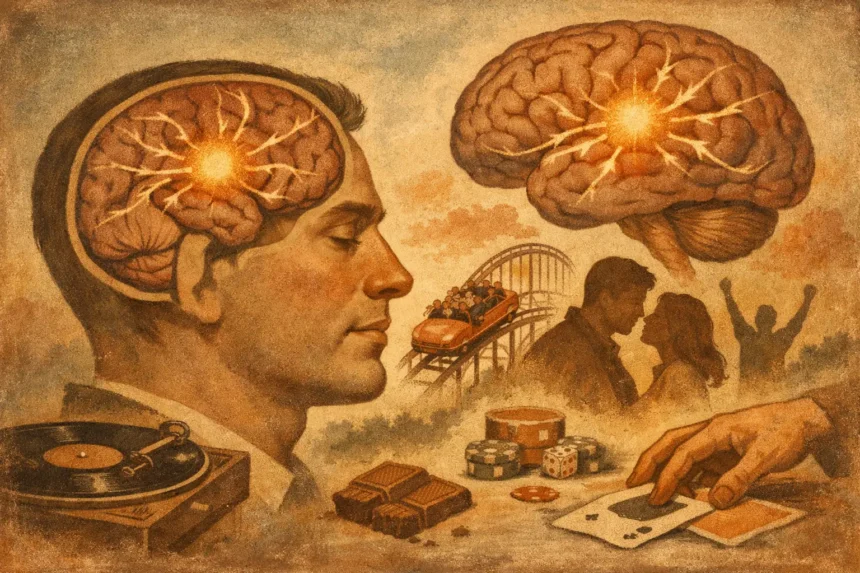
People often associate dopamine with pleasure because the two can overlap. Activities like eating, sex, music, novelty, and achievement can all involve dopamine. But overlap is not the same as identity.
Pleasure itself involves multiple brain systems, including opioid and endocannabinoid pathways. Dopamine often shows up earlier, when you want something, seek something, or learn that something is valuable. In plain English, dopamine is heavily involved in wanting. Liking is a related but different process.
This matters because it explains a strange but common experience: you can strongly crave something without deeply enjoying it once you get it. That gap between wanting and liking is one reason habits can feel compulsive. The motivational engine keeps running even when the emotional payoff gets weaker.
What dopamine actually does to your brain when habits form
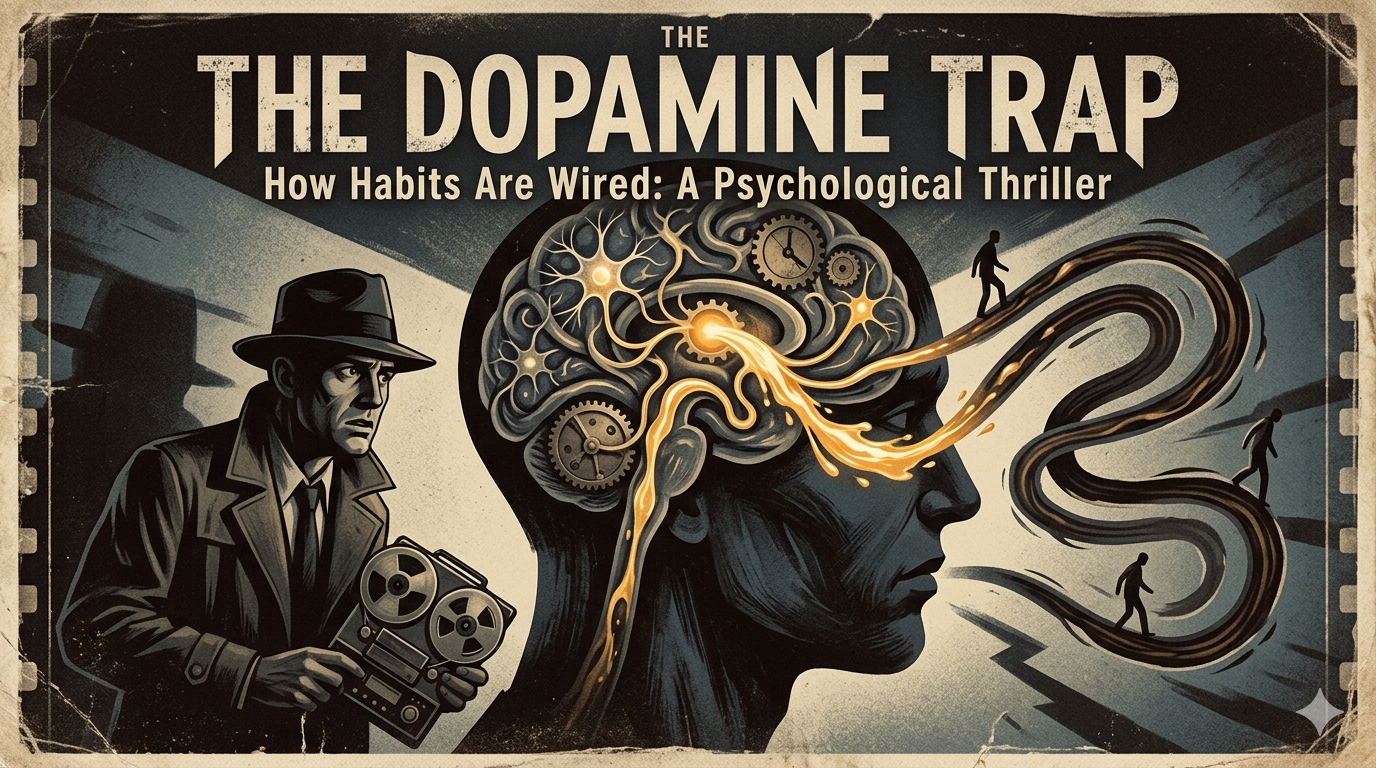
Habits are not just repeated actions. They are learned shortcuts. Dopamine helps build those shortcuts by strengthening the connection between cues, actions, and outcomes.
At first, dopamine activity may spike when you get the reward itself. But over time, that spike can shift to the cue predicting the reward. The sound of a notification, the sight of a vending machine, the time of day you usually reach for coffee – all of these can become loaded with motivational significance.
That is why behavior change is rarely about willpower alone. If your brain has learned that certain cues predict something rewarding, those cues start pulling attention and behavior almost automatically. You are not weak. Your brain is doing exactly what learning systems are designed to do.
The trade-off is that the same system that helps you build useful routines can also lock in unhelpful ones. Dopamine does not morally evaluate your habits. It strengthens what gets repeated and what seems predictive of value.
Dopamine and attention: why some things suddenly feel urgent
Dopamine also influences attention. It helps the brain allocate mental resources toward things that seem relevant, novel, or potentially rewarding. That can be helpful. It is part of why goals can energize you and why curiosity feels mentally activating.
But in a hyper-stimulating environment, this system can get pulled in too many directions. Apps, alerts, short-form videos, and endless novelty compete for the same basic mechanism: they present cues that might lead to something interesting. The result is not just a distraction. It is a brain repeatedly trained to orient toward high-salience signals.
This is where people sometimes talk about having “fried their dopamine.” That phrase is sloppy, but it points to a real frustration. When your attention is constantly captured by fast, variable rewards, slower rewards can start to feel flat. Reading a book, doing deep work, or having an unhurried conversation may not be less valuable. They may just be less optimized for grabbing your motivational circuitry.
That does not mean your brain is broken. It means your reward environment matters.
Low dopamine is not a personality flaw
Because dopamine is tied to motivation, people often reduce low motivation to low dopamine. Sometimes that is partly relevant, but the real picture is more complicated.
Dopamine function is involved in conditions such as Parkinson’s disease, ADHD, schizophrenia, and substance use disorders, but these are not simple cases of “too much” or “too little” dopamine. Different pathways do different jobs. Receptor sensitivity matters. Context matters. Other neurotransmitters matter too.
Even in everyday life, feeling unmotivated is not proof that you have a dopamine problem. Sleep deprivation, chronic stress, depression, burnout, uncertainty, and lack of meaningful rewards can all reduce drive. If your brain does not see a path from effort to payoff, motivation can stall.
That is one reason vague productivity advice often fails. People do not just need more discipline. They often need a clearer reward structure, less cognitive overload, or goals that actually feel psychologically real.
The myth of the dopamine detox

The idea of a “dopamine detox” became popular because it offers an appealing story: overstimulation has hijacked your brain, and a short reset can fix it. There is a grain of truth here, but the framing is misleading.
You cannot detox from dopamine in any literal sense. Dopamine is not a toxin. It is essential for normal brain function. What people are usually trying to do is reduce overstimulating inputs so that attention and motivation can recalibrate.
That can help. Spending less time with highly engineered reward loops may make it easier to tolerate boredom, sustain focus, and reconnect with lower-intensity activities. But this is not about purging dopamine. It is about retraining what your brain expects from reward.
A better question is not, “How do I eliminate dopamine spikes?” It is, “What kind of reward environment am I building around myself?” If your daily life teaches your brain to expect constant novelty and instant payoff, effortful tasks will feel harder. If you repeatedly pair satisfaction with slower, meaningful rewards, motivation can become less fragile.
So what should you do with this knowledge?
The practical value of understanding dopamine is not that it gives you a new buzzword. It helps you see behavior more clearly.
If you want to change a habit, focus on cues and rewards, not just intentions. If you want more motivation, make the next step visible and the payoff believable. If your attention feels shredded, look at the structure of your environment before blaming your character.
This is where evidence-based psychology is more useful than self-help mythology. Your brain is not simply chasing pleasure. It is learning from patterns, updating predictions, and assigning value all day long. The Psychology of Everything exists in that space between simplistic explanations and real human behavior – where understanding the mechanism gives you more leverage over your life.
Dopamine will probably keep getting reduced to headlines, hacks, and hot takes. But the truth is better than the myth. Your brain uses dopamine to learn what to pursue, what to ignore, and what to try again. Pay attention to that, and you start seeing your habits, cravings, and attention not as random flaws, but as signals shaped by the world you keep repeating.