

- Why mental health myths spread so easily
- Common mental health myths explained clearly
- Myth 1: Mental health problems are rare
- Myth 2: If you are strong, you should handle it on your own
- Myth 3: Therapy is only for severe problems
- Myth 4: Medication changes who you are
- Myth 5: You can always tell when someone is struggling
- Myth 6: Mental illness is caused by a chemical imbalance
- Myth 7: Talking about suicide puts the idea into someone’s head
- Myth 8: Recovery means never struggling again
- What these myths get wrong about human behavior
- How to think more clearly about mental health
If you have ever heard someone say therapy is only for people in crisis, or that anxiety is just overthinking, you have already seen how common mental health myths explained poorly can shape real behavior. Myths do not stay abstract for long. They affect whether people ask for help, how they judge themselves, and what they expect recovery to look like.
That matters because mental health misinformation often sounds plausible. It borrows the language of resilience, personal responsibility, or common sense. But psychology tends to be less tidy than popular advice suggests. Human distress is not always visible, motivation is not the same as wellness, and getting better is rarely a straight line.
Why mental health myths spread so easily
Mental health sits in a strange cultural space. People talk about it more than they used to, but many still rely on outdated assumptions, social media clichés, and movie-level stereotypes. A myth survives when it offers a simple story for something complex.
There is also a psychological reason myths stick. We prefer explanations that feel intuitive. If someone looks high functioning, we assume they are fine. If a person cannot get out of bed, we call it laziness because that feels easier to categorize than depression, burnout, trauma, grief, or some mix of all four. The brain likes shortcuts, even when those shortcuts distort reality.
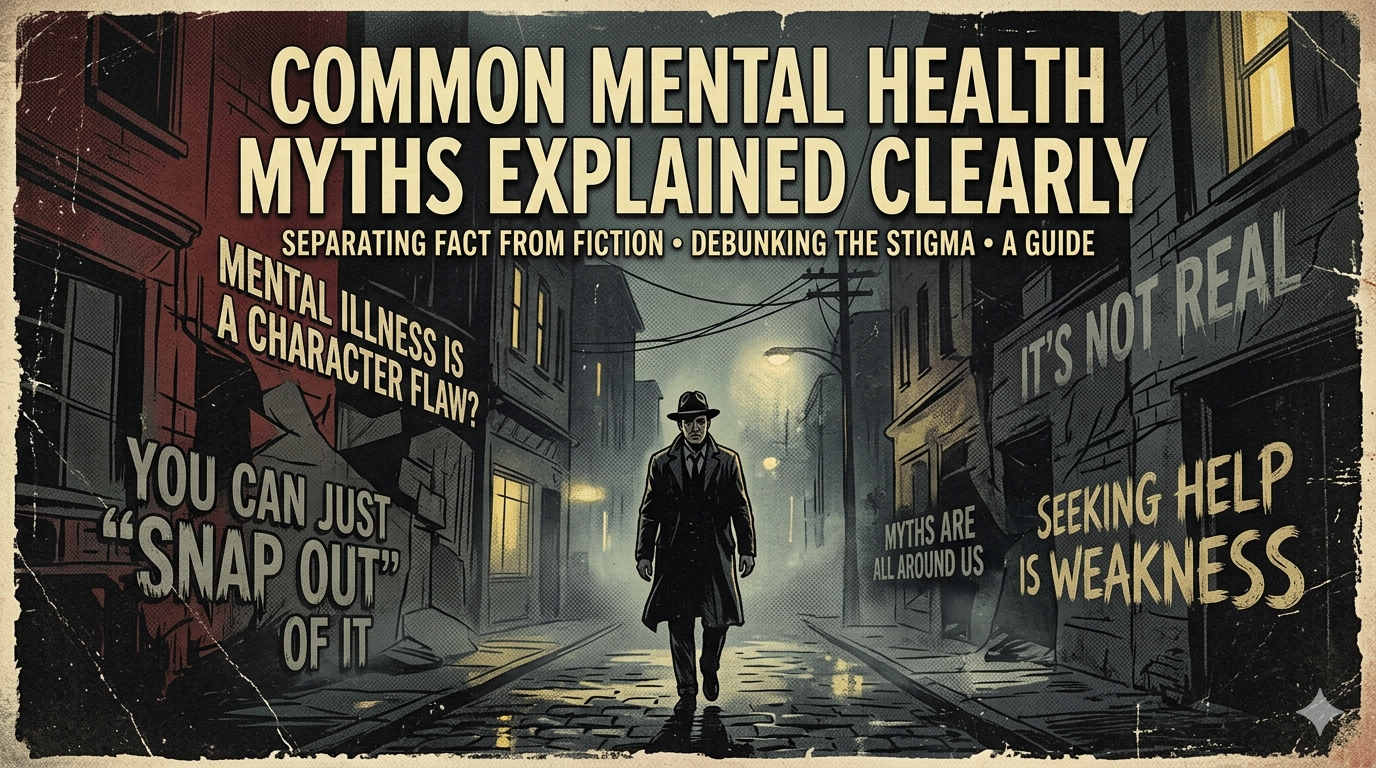
Common mental health myths explained clearly
Myth 1: Mental health problems are rare
They are not. Mental health difficulties are common across age groups, workplaces, families, and social circles. Not every bad week is a disorder, and not every emotional struggle needs a diagnosis, but clinically significant anxiety, depression, trauma-related symptoms, substance use issues, and other conditions are far from unusual.
This myth persists because many people hide what they are dealing with. Mental health symptoms are often internal, managed privately, or masked by work performance and social functioning. You can seem competent and still be struggling hard.
Myth 2: If you are strong, you should handle it on your own
This is one of the most damaging ideas in circulation. It reframes support-seeking as weakness, when in reality it often reflects self-awareness and good judgment. We do not apply this logic consistently elsewhere. Nobody says a broken ankle should be managed alone to prove character.
Psychologically, isolation tends to make distress worse. Rumination grows in private. Shame thrives without correction. External support, whether from a therapist, doctor, trusted friend, or family member, can interrupt distorted thinking and help people regulate stress before it becomes more severe.
There is nuance here. Not everyone needs formal therapy for every challenge. Some people benefit most from social support, sleep, structure, exercise, or temporary stress reduction. But the broader myth still fails because self-reliance is not the same as mental health.
Myth 3: Therapy is only for severe problems
Therapy can help with severe conditions, but that is only part of the picture. People also use therapy for relationship patterns, work stress, identity questions, grief, perfectionism, emotional regulation, and recurring habits that keep undermining their lives.
Think of therapy less as an emergency-only service and more as a structured environment for understanding behavior, emotion, and change. Sometimes the goal is symptom relief. Sometimes it is insight. Often it is both.
The trade-off is that therapy is not magic, and it is not one-size-fits-all. A poor fit between therapist and client can slow progress. Different approaches work better for different issues. Good therapy is evidence-informed, collaborative, and realistic about time and effort.
Myth 4: Medication changes who you are
This myth usually comes from fear of losing control or becoming emotionally flat. Those concerns are understandable, especially because people can have side effects and not every medication works the same way for every person.
But the claim that medication automatically erases personality is misleading. For many people, effective medication reduces symptoms that were already distorting daily life, such as panic, intrusive thoughts, severe depressive slowing, or unstable mood. In those cases, treatment can make someone feel more like themselves, not less.
Medication is also not the only route, and it is not the right fit for everyone. The useful question is not whether medication is good or bad in the abstract. It is whether the likely benefits, side effects, symptom severity, and available alternatives make sense for a specific person with proper medical guidance.
Myth 5: You can always tell when someone is struggling
You usually cannot. This is where appearance becomes a terrible diagnostic tool. Some people who are deeply anxious are highly productive. Some people with depression still show up, smile, parent well, and answer emails. Others become withdrawn and visibly distressed. There is no single look.
This myth creates two problems at once. It causes outsiders to miss real suffering, and it causes struggling people to believe they are not sick enough to deserve help. If your life has not completely fallen apart, you might minimize symptoms that are still serious and treatable.
Myth 6: Mental illness is caused by a chemical imbalance
This phrase became popular because it is simple, memorable, and partly related to biology. But it is too simple to explain mental health accurately. Most mental health conditions do not have a single cause. They emerge from an interaction of genetics, stress, learning history, social environment, trauma exposure, personality traits, physical health, and yes, brain processes.
The chemical imbalance idea can reduce stigma when it helps people see mental illness as real rather than imagined. But it can also become reductive. It implies a neat mechanical problem with a neat fix, when the reality is often messier. Human psychology is biopsychosocial, not one-dimensional.
Myth 7: Talking about suicide puts the idea into someone’s head
Evidence suggests the opposite. Asking someone directly and calmly about suicidal thoughts does not implant the idea. It can reduce isolation and make it easier for the person to speak honestly.
People in crisis often feel trapped, ashamed, or convinced that nobody wants to hear the truth. Avoiding the topic may protect the comfort of the person asking, but it does not protect the person suffering. What helps more is clear, nonjudgmental conversation and immediate support from qualified professionals or emergency services when risk is present.
Myth 8: Recovery means never struggling again
This is one of the most subtle myths because it sounds hopeful. In practice, it sets people up to feel like failures the moment symptoms return. Recovery in mental health usually means better functioning, stronger coping, improved insight, and longer periods of stability. It does not always mean permanent immunity from stress, relapse, or hard seasons.
That does not make recovery less real. It makes it more realistic. Many people get significantly better while still needing ongoing habits, boundaries, treatment, or support. The goal is not perfection. It is a life that becomes more manageable, meaningful, and less dominated by symptoms.
What these myths get wrong about human behavior

The deeper pattern behind these misconceptions is a tendency to moralize distress. We confuse symptoms with personality. We treat exhaustion as laziness, anxiety as fragility, and emotional numbness as indifference. But mental health problems are not character verdicts.
They are patterns of thought, emotion, physiology, and behavior that can become entrenched under pressure. Some develop gradually. Others follow trauma, loss, chronic stress, or major life transitions. Context matters more than most myths allow.
This is why evidence-based psychology is so useful. It cuts through the pseudo-science and self-blame. It reminds us that mental health is shaped by systems, habits, relationships, biology, and environments, not just willpower.
How to think more clearly about mental health
A better approach starts with curiosity over certainty. Instead of asking, “What is wrong with this person?” ask, “What might be happening here?” That shift sounds small, but it changes everything. It opens the door to better interpretation, less stigma, and more accurate decisions.
It also helps to separate discomfort from disorder without dismissing either. Not every painful emotion is a mental illness. Stress before a presentation, grief after a loss, or sadness during a breakup can be normal. But normal does not mean easy, and distress does not need to become catastrophic before it deserves attention.
If you want to cut through the myths and pseudo-science around human behavior, that mindset matters. It is the same reason platforms like The Psychology of Everything resonate with so many readers. Psychology becomes far more useful when it helps people interpret real life, not just label it.
The most helpful thing to remember is this: mental health is not a test of toughness. It is part of being human, and like every other part of being human, it deserves honesty, better language, and more intelligent care.