


- What emotional intelligence actually means
- Emotional intelligence: the complete guide to the core skills
- Why emotional intelligence matters more than people assume
- Common myths that need to go
- How to build emotional intelligence in real life
- Where emotional intelligence gets complicated
- Emotional intelligence and mental health are related, but not identical
- A better way to think about emotional intelligence
Most people think emotional intelligence is about being nice, staying calm, or reading the room with near-psychic accuracy. That version is popular, flattering, and wrong. Emotional Intelligence: The Complete Guide starts somewhere less glamorous – with the ability to notice what you feel, understand why it is happening, and respond in a way that actually helps rather than quietly makes things worse.
That matters because emotions are not side noise. They shape attention, memory, judgment, motivation, relationships, and the stories people tell about themselves. If you want to understand why smart people sabotage good opportunities, why conflict escalates so fast, or why some people recover from stress better than others, emotional intelligence is part of the answer.
What emotional intelligence actually means
In psychology, emotional intelligence usually refers to a set of abilities related to perceiving, understanding, using, and managing emotions. Depending on the model, it is treated either as a skill set or as a broader mix of emotional competencies and personality tendencies. That distinction matters because many online discussions blur everything together.
The skills-based view asks questions like: Can you accurately identify what you are feeling? Can you recognize emotion in other people? Can you understand how emotions change thinking and behavior? Can you regulate emotion without suppressing it or letting it run the show?
The broader trait view includes how emotionally capable people believe themselves to be in everyday life. That can overlap with personality. Someone high in empathy, self-confidence, and stress tolerance may score well on trait measures even if their actual emotion-reading ability is only average.
This is where hype tends to creep in. Emotional intelligence is useful, but it is not a magic trait that guarantees success, kindness, or mental health. A person can be emotionally perceptive and still manipulative. Another can be emotionally sincere and still poor at regulation under pressure. Like most psychology, the real picture is more interesting than the myth.

Emotional intelligence: the complete guide to the core skills
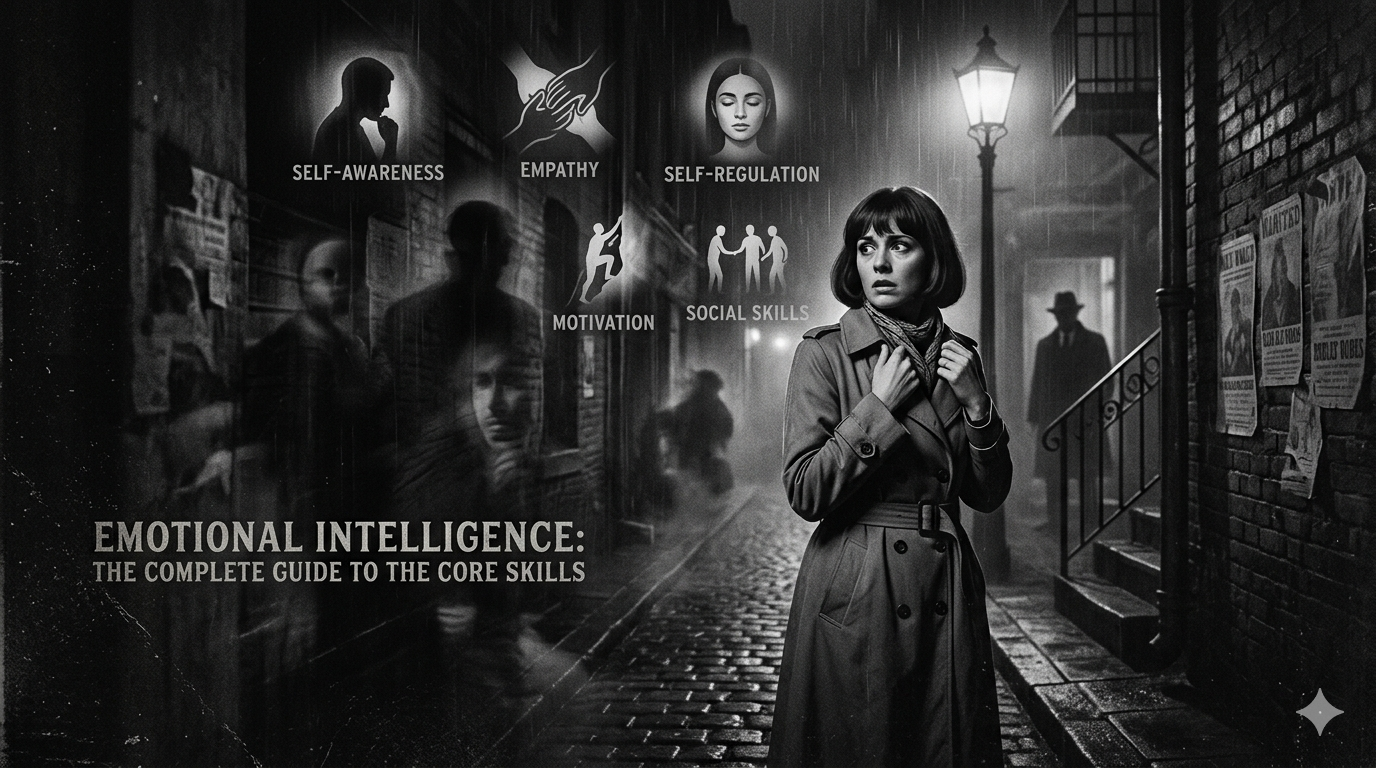
If you strip away buzzwords, emotional intelligence rests on four core capacities.
Self-awareness comes first. This is the ability to identify your internal state with enough precision to make sense of it. Not just I feel bad, but I feel embarrassed, threatened, disappointed, overstimulated, or resentful. That level of specificity changes what you do next. A lot of emotional confusion is really labeling failure.
Self-regulation is what happens after awareness. It does not mean shutting feelings down or acting unfazed. It means being able to pause, interpret the signal correctly, and choose a response that fits your goals. Sometimes that means calming yourself. Sometimes it means speaking up instead of avoiding discomfort.
Social awareness is the outward-facing side of emotional intelligence. It includes empathy, but empathy is not mind-reading, and it is not automatic agreement. It is the capacity to pick up emotional cues, consider another person’s perspective, and understand the social context shaping their behavior.
Relationship management builds on all of the above. This is where emotional intelligence becomes visible: handling conflict without unnecessary damage, giving feedback that lands, apologizing well, setting boundaries, and knowing when a conversation needs reassurance, honesty, or space.
Why emotional intelligence matters more than people assume
Plenty of decisions that look rational on the surface are emotionally driven underneath. Career choices are often shaped by status anxiety, fear of failure, belonging, or resentment. Relationship arguments are rarely about the stated issue alone. A fight about texting back may actually be about insecurity, power, neglect, or mismatched expectations.
Emotional intelligence helps because it improves signal detection. It lets you catch the real driver before you build a whole story around the wrong one. That does not make life frictionless, but it does make your interpretations more accurate.
It also affects performance. Emotion influences focus, working memory, and risk perception. A person who can regulate panic during a presentation, recover after criticism, or notice burnout before it collapses has a practical advantage. This is not corporate jargon. It is a basic cognitive reality.
The relationship piece is just as important. People tend to trust those who make them feel understood, not just impressed. Emotional intelligence helps you notice when someone wants problem-solving and when they want validation first. Get that wrong consistently, and even good intentions can feel cold.
Common myths that need to go
One myth is that high emotional intelligence means being endlessly patient, agreeable, and gentle. It does not. Sometimes, the emotionally intelligent move is directness. Sometimes it is a firm boundary. Sometimes it is ending a conversation because nobody is thinking clearly.
Another myth is that emotional intelligence is the opposite of logic. In reality, emotions carry information about needs, values, threats, and motivations. They are not always accurate, but ignoring them does not make you more rational. It just makes you less informed about what is driving you.
A third myth is that emotional intelligence is fixed. Some parts are easier for some people because of temperament, upbringing, or social learning, but these skills are trainable. The catch is that improvement usually looks less dramatic than social media promises. It comes from repeated practice in ordinary moments.
How to build emotional intelligence in real life

Start with emotional granularity. Instead of naming everything as stress, pause and ask what kind of stress it is. Is it pressure, dread, shame, uncertainty, anger, overload, or anticipation? More precise labeling is linked to better regulation because it turns a vague emotional flood into something the mind can work with.
Next, track your patterns rather than judging them. Which situations reliably activate you? What story do you instantly tell yourself? What action usually follows? For example, if delayed replies trigger rejection fears, the goal is not to mock yourself for being dramatic. It is necessary to notice the chain early enough to interrupt it.
That interruption matters. Emotional intelligence often lives in the gap between feeling and reaction. Before sending the defensive text, withdrawing from a partner, or saying yes when you mean no, ask a better question: what outcome am I about to create if I act from this feeling at full speed?
Perspective-taking helps, too, but it works best when it is grounded rather than overly charitable. Try to generate two or three plausible explanations for another person’s behavior instead of assuming the one that hurts most. This reduces emotional certainty, which is often where bad interpretations harden into conflict.
Finally, practice communication that names emotion without turning it into an accusation. There is a major difference between saying you never respect me and saying I felt dismissed when that happened. One invites defense. The other gives the conversation a chance.
Where emotional intelligence gets complicated
Like any psychological strength, emotional intelligence has trade-offs. High empathy without boundaries can become emotional exhaustion. Strong social awareness can slide into people-pleasing. Good emotional perception can be used to connect, but it can also be used to persuade, charm, or manipulate.
Context matters too. The emotionally intelligent response at work may not be the same as the emotionally intelligent response in a close relationship. In one setting, restraint may be wise. In another, emotional honesty may be the healthier move. There is no single perfect script because emotions are always happening inside a social environment with power, norms, and consequences.
Culture also shapes what emotional skill looks like. Direct expression is valued in some settings and seen as disruptive in others. That does not mean emotional intelligence is fake. It means part of emotional competence is reading the context instead of treating your own communication style as universal.
Emotional intelligence and mental health are related, but not identical
This is an easy place to get sloppy. Emotional intelligence can support mental health by improving coping, reducing impulsive reactions, and strengthening relationships. But it is not a substitute for therapy, medication, or deeper clinical support when those are needed.
Someone can understand their emotions very well and still struggle with depression, trauma, anxiety, or mood instability. In fact, some people are highly emotionally aware but get stuck in rumination rather than regulation. Insight helps, but insight alone does not always heal.
That is one reason evidence-based psychology matters. The goal is not to romanticize emotional depth. The goal is to cut through the myths and pseudo-science and get more accurate about what actually improves functioning.
A better way to think about emotional intelligence
The most useful definition is not charisma, softness, or social polish. It is emotional accuracy plus behavioral flexibility. Can you read what is happening inside you and around you with enough honesty to respond well?
That question follows you everywhere – into dating, work, ambition, conflict, parenting, friendship, and self-respect. And if you want to build it, start smaller than you think. Notice the feeling. Name it precisely. Question the first story it gives you. Then choose the response you will still respect tomorrow.