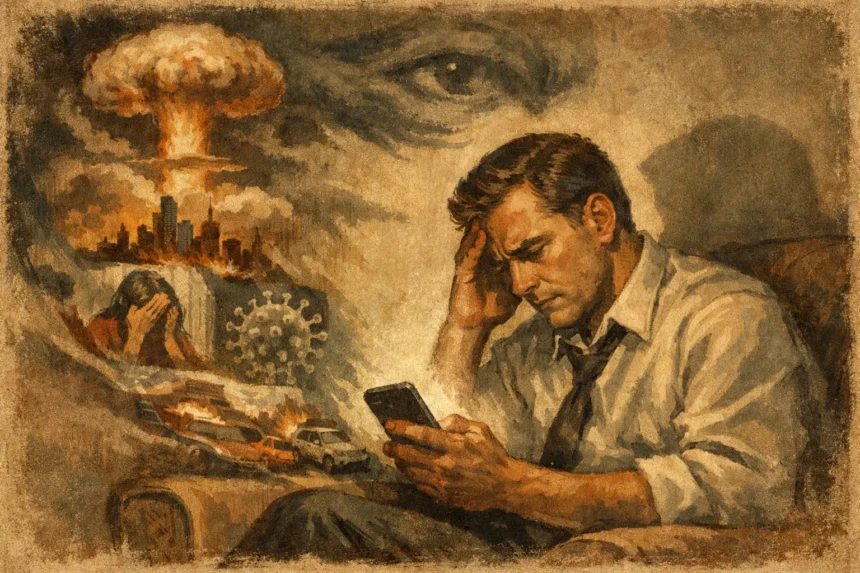
You check one headline before bed. Twenty minutes later, you are knee-deep in war updates, layoffs, climate disasters, celebrity scandals, and a comment section that somehow made all of it worse. You are not relaxed, informed, or even especially surprised. Yet you keep going. The psychology of doomscrolling starts there – in the strange gap between what we know will make us feel worse and what we do anyway.
Doomscrolling is often framed as a self-control problem, but that explanation is too thin. If it were only about discipline, smart and self-aware people would be immune. They are not. Doomscrolling is better understood as a collision between ancient threat-detection systems and modern information environments designed to keep attention from drifting away.
What the psychology of doomscrolling actually reveals
At its core, doomscrolling is repetitive consumption of negative, threatening, or emotionally loaded information, usually on digital platforms with endless feeds. The behavior feels passive, but psychologically it is active. Your brain is scanning for cues about danger, uncertainty, status, and control.
Humans are not neutral information processors. We are biased toward threat. This is not a design flaw. It is part of how we survived. Missing one sign of danger mattered more than missing one sign that everything was fine. That old asymmetry still shapes attention now, even when the “danger” is a stream of global news updates you cannot personally act on.
This is where negativity bias matters. Negative information tends to grab attention faster, feel more urgent, and stick in memory longer than positive information. A calm headline rarely creates the same internal jolt as one suggesting collapse, contamination, violence, or social chaos. Doomscrolling works because your brain keeps treating each new alarming post as potentially important.
But threat sensitivity alone does not explain why people scroll long after the information stops being useful. For that, uncertainty is the bigger story.

Why uncertainty keeps you stuck
People do not only seek pleasant information. We seek to reduce information. When the world feels unstable, the brain starts acting like more data will produce relief. Sometimes it does. Often it does not.
In uncertain conditions, checking becomes emotionally seductive. One more post might clarify what is happening. One more thread might reveal the truth. One more expert video might finally make the situation feel manageable. That expectation creates a loop: anxiety increases the urge to check, checking exposes you to more alarming information, and that information keeps anxiety alive.
Psychologists sometimes describe this as negative reinforcement. The scrolling is not rewarding because it feels good. It is rewarding because it briefly relieves the discomfort of not knowing. Even a short-lived sense of “at least I am staying on top of this” can train the habit.
The problem is that digital feeds rarely resolve uncertainty. They multiply it. For every answer, there is another contradiction, another rumor, another update, another worst-case interpretation. So the behavior that promises control often produces the opposite.
Doomscrolling is not just about fear
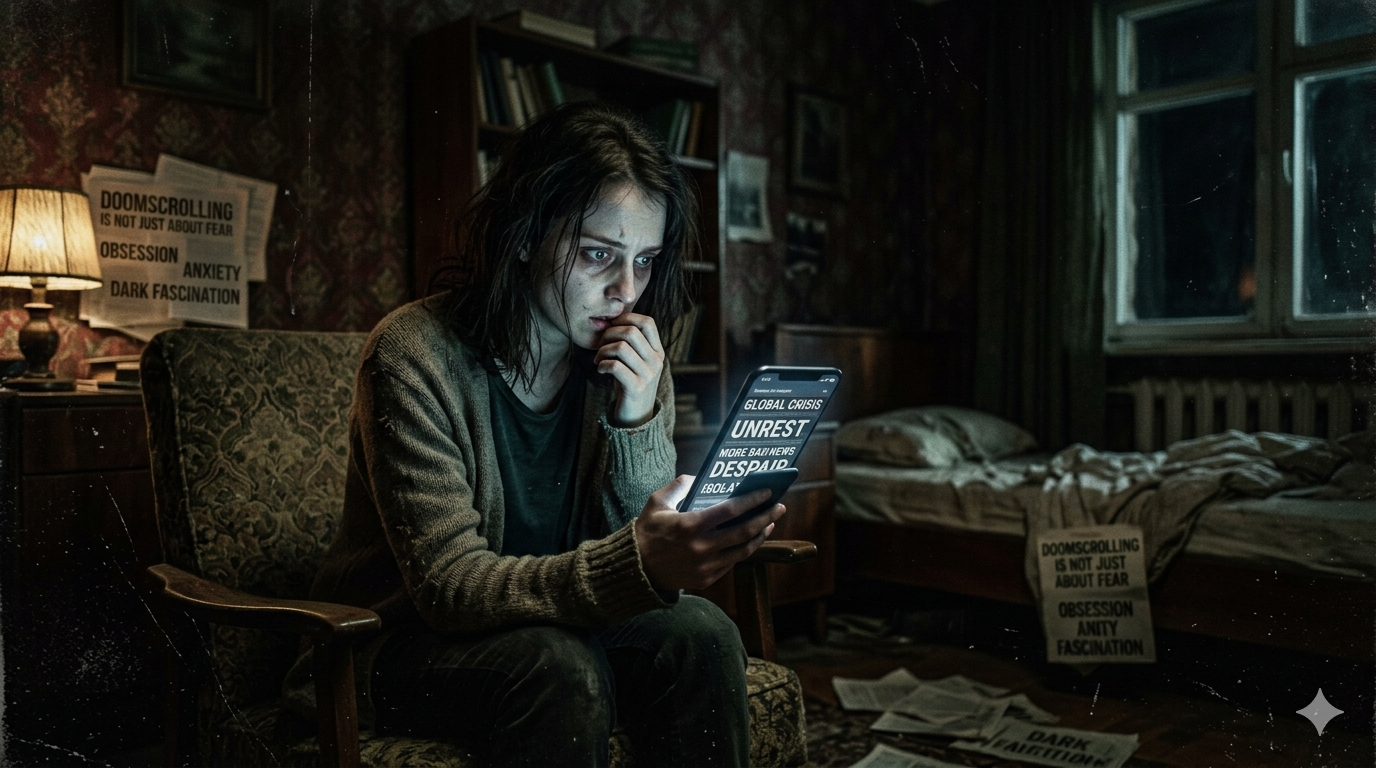
Fear is part of it, but doomscrolling also taps into social psychology. People monitor bad news for identity reasons, moral reasons, and status reasons.
In some social circles, being informed is part of being good. If major events are unfolding, not paying attention can feel irresponsible or privileged. That creates a subtle moral pressure to keep watching, even when the information is repetitive and psychologically draining. The result is a behavior that feels virtuous in the moment but leaves you emotionally depleted.
There is also a social comparison layer. Seeing everyone else posting about a crisis can trigger the sense that you should know more, care more, and react more. The feed does not just deliver information. It tells you what other people seem to think matters right now. That can intensify the fear of missing something important, especially for people who already tie self-worth to competence, awareness, or being socially plugged in.
Then there is outrage. Doomscrolling is often mixed with anger, disgust, and moral judgment. Those emotions are activating. They make people feel alert, righteous, and mentally engaged. That can create the illusion of productive attention, even when the behavior is mostly just emotional marination.
The design problem most people underestimate
If doomscrolling happened in a newspaper, it would burn out faster. You would hit the end. Social feeds remove the endpoint.
That matters because the brain is highly sensitive to variable rewards. You do not know whether the next swipe will bring something trivial, terrifying, clarifying, or oddly validating. Unpredictability is powerful. It keeps behavior going longer than consistent rewards do.
This is one reason the psychology of doomscrolling overlaps with habit formation and compulsive checking. The feed is not just delivering content. It is delivering intermittent reinforcement. Most posts may be forgettable, but every so often, one feels essential. That occasional hit keeps the loop alive.
Platforms also privilege emotionally intense content because intensity drives engagement. Content that provokes alarm, rage, or urgency spreads more easily than content that is careful and calming. So even if your goal is simply to stay informed, the environment is structured to show you information in its most psychologically sticky form.
Who is most vulnerable?
Almost anyone can get pulled in, especially during periods of collective crisis. Still, some people are more susceptible.
If you are already anxious, your attention is more likely to lock onto threat cues. If you are highly conscientious, you may confuse over-monitoring with responsibility. If you feel low control in your personal life, information tracking can become a substitute for agency. And if you are lonely or emotionally tired, scrolling may function as a numbing ritual as much as an information habit.
It also depends on context. A person may barely doomscroll during stable periods, then suddenly fall into it during elections, health scares, economic shocks, or personal upheaval. That is why blanket advice like “just stop looking at your phone” usually misses the point. Doomscrolling is not a fixed personality flaw. It is a behavior that becomes more likely under certain psychological and environmental conditions.
What doomscrolling does to your mind
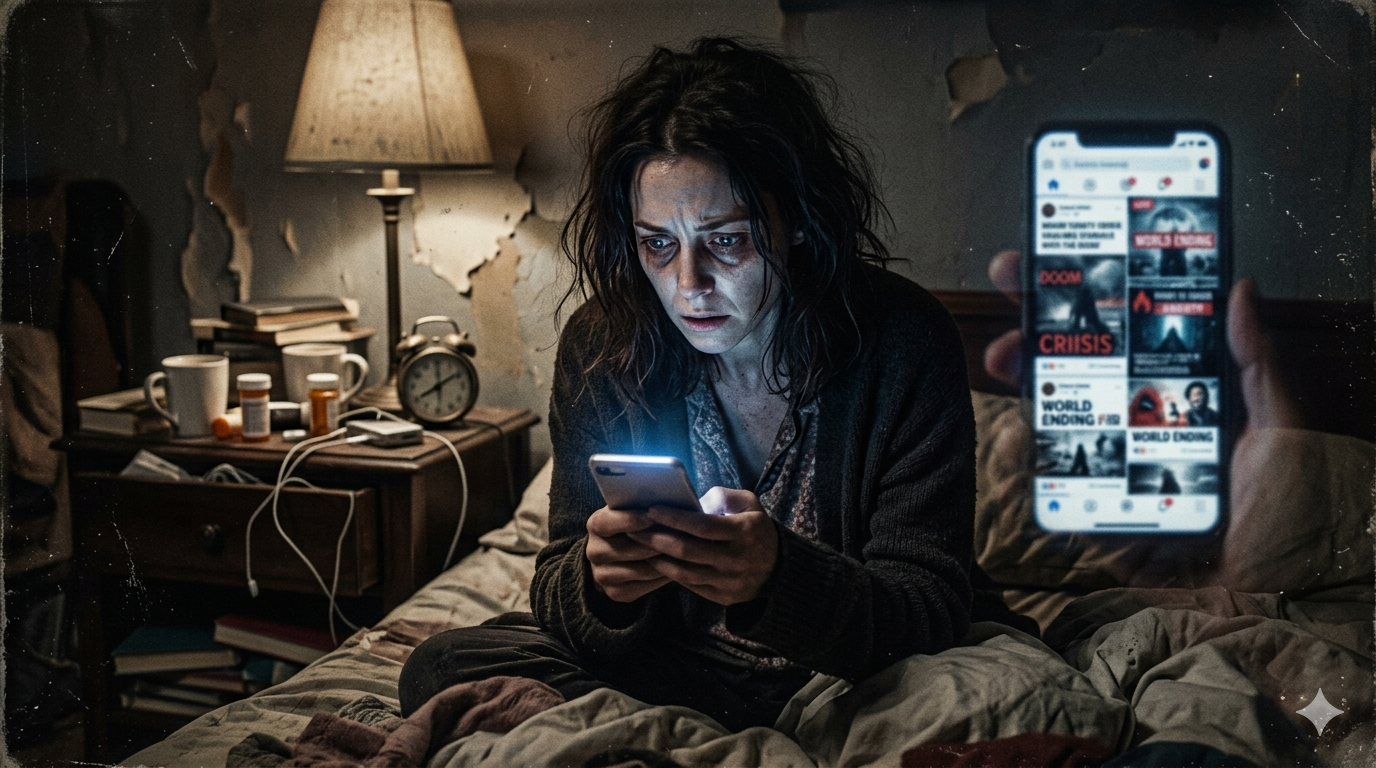
The immediate effect is usually not insight. It is dysregulation.
Repeated exposure to threatening content can heighten vigilance, increase stress, and make the world feel more dangerous than your direct experience would suggest. This does not mean the threats are unreal. It means constant exposure changes salience. The brain starts weighing danger cues more heavily, which can distort judgment, sleep, mood, and concentration.
There is also a cognitive cost. Attention becomes fragmented. Instead of processing one issue well, you absorb many fragments badly. You end up with a mind full of emotional residue and very little genuine understanding.
For some people, doomscrolling also blurs into helplessness. When you consume problem after problem without a meaningful path to action, distress can harden into fatalism. That is one of the quieter harms. A person can mistake saturation for awareness while becoming less capable of thoughtful response.
How to interrupt the loop without pretending the world is fine
The most useful response is not total avoidance. It is friction, structure, and intention.
Start by separating information-seeking from emotional compulsion. Before opening an app, ask a blunt question: What am I trying to find out right now? If there is no answer, the urge is probably not about information. It is about regulation.
Next, change the architecture. Endless feeds are the problem, so replace them where possible with finite formats. Read a morning briefing instead of live-updating posts. Check at set times rather than in open-ended bursts. If you notice that late-night scrolling hits hardest, treat that as a design issue, not a character issue. Move the app, log out, or create a harder path to access.
It also helps to pair exposure with action. If a topic matters to you, choose one concrete response: donate, volunteer, contact a representative, talk to someone affected, or set a boundary around how you will stay informed. Action does not erase distress, but it reduces the helplessness that keeps compulsive monitoring alive.
And pay attention to your internal state after consuming news. More informed is not the same as more flooded. If a session leaves you wired, numb, and no clearer than before, that is data. Your brain is telling you the behavior has crossed from useful vigilance into costly overexposure.
At The Psychology of Everything, we spend a lot of time cutting through myths about human behavior. One of the biggest myths here is that doomscrolling means you are weak, irrational, or uniquely bad at modern life. In reality, it means your mind is doing what human minds do: searching for safety, clarity, and control in an environment expertly built to withhold all three.
The better question is not whether you can become the kind of person who never gets pulled in. It is whether you can notice the pull sooner, understand what it is doing to you, and build habits that protect your attention before your attention starts shaping your reality.