

- How habits are formed in the brain
- The cue-routine-reward loop is useful, but incomplete
- Repetition helps, but context is what locks habits in
- Emotion plays a bigger role than most people realize
- Identity shapes habits, and habits shape identity
- Why some habits form quickly, and others never stick
- How to use psychology to build better habits
- The myth of perfect consistency
You do not wake up one day as “a morning person,” “a gym person,” or “someone who always procrastinates.” Those identities usually arrive later, after a behavior has repeated enough times that your brain starts treating it as the default. That is the core of how habits are formed: not through willpower alone, but through a gradual process in which actions become easier, faster, and less conscious.
That matters because people often blame themselves for having “bad discipline” when the real issue is behavioral design. Habits are not moral achievements. They are learned patterns. And once you understand the psychology behind them, a lot of everyday behavior starts to make more sense – from doomscrolling at midnight to automatically reaching for your running shoes after work.
How habits are formed in the brain
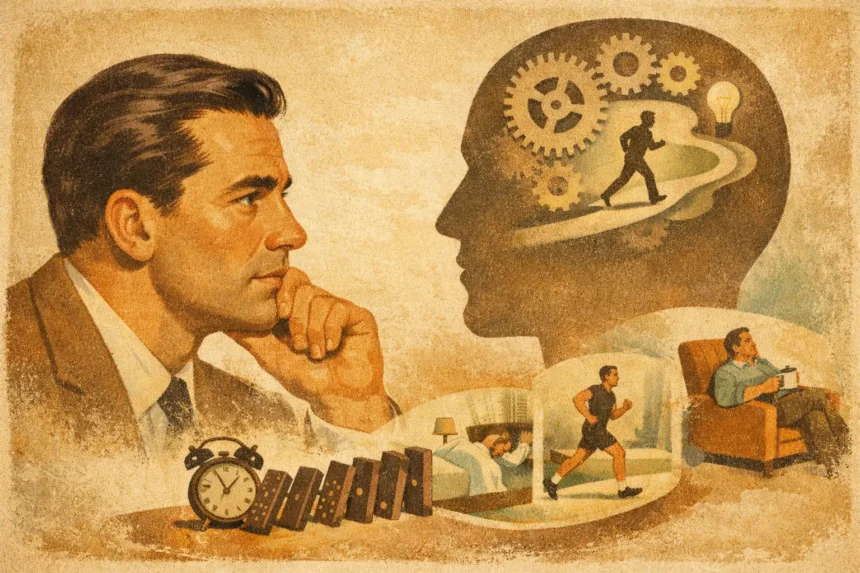
A habit is a behavior that becomes relatively automatic in response to a repeated context. The keyword here is automatic. Habits do not mean you never make a choice. They mean the choice starts requiring less mental effort.
Early on, a new behavior demands attention. You have to remember it, initiate it, and often push through resistance. Over time, if the same behavior keeps happening in the same situation, the brain begins to compress that sequence. Instead of actively deciding each step, you start responding to cues with less conscious deliberation.
This is one reason habits can feel strangely detached from your goals. You can genuinely want to cut back on social media and still open an app without thinking. The behavior is no longer being driven only by your current intentions. It is being pulled by context, repetition, and reward history.
A lot of this learning involves brain systems linked to reward prediction, attention, and procedural memory. The popular version of this story is often oversimplified into “neurons that fire together wire together.” That is not entirely wrong, but it misses the behavioral point. Habits are not formed just because you repeat something a lot. They are formed because the brain learns, “When this situation happens, this response tends to work.”

The cue-routine-reward loop is useful, but incomplete
One of the most familiar explanations of habit formation is the cue-routine-reward loop. It is popular for a reason. A cue triggers a behavior, the behavior leads to some reward, and that reward makes the behavior more likely to happen again in the future.
That framework is helpful, but it can sound cleaner than real life. Rewards are not always obvious or rational. The “reward” for checking your phone may not be pleasure in a simple sense. It might be relief from boredom, a break from uncertainty, or a tiny hit of social reassurance. Likewise, the cue is often not just one thing. It can be a time of day, a place, an emotional state, or the presence of other people.
That complexity matters. If you think your habit exists because you lack self-control, you will probably try to fix it by putting in more effort. If you realize the behavior is tied to specific cues and rewards, you can change the system around it.
Repetition helps, but context is what locks habits in
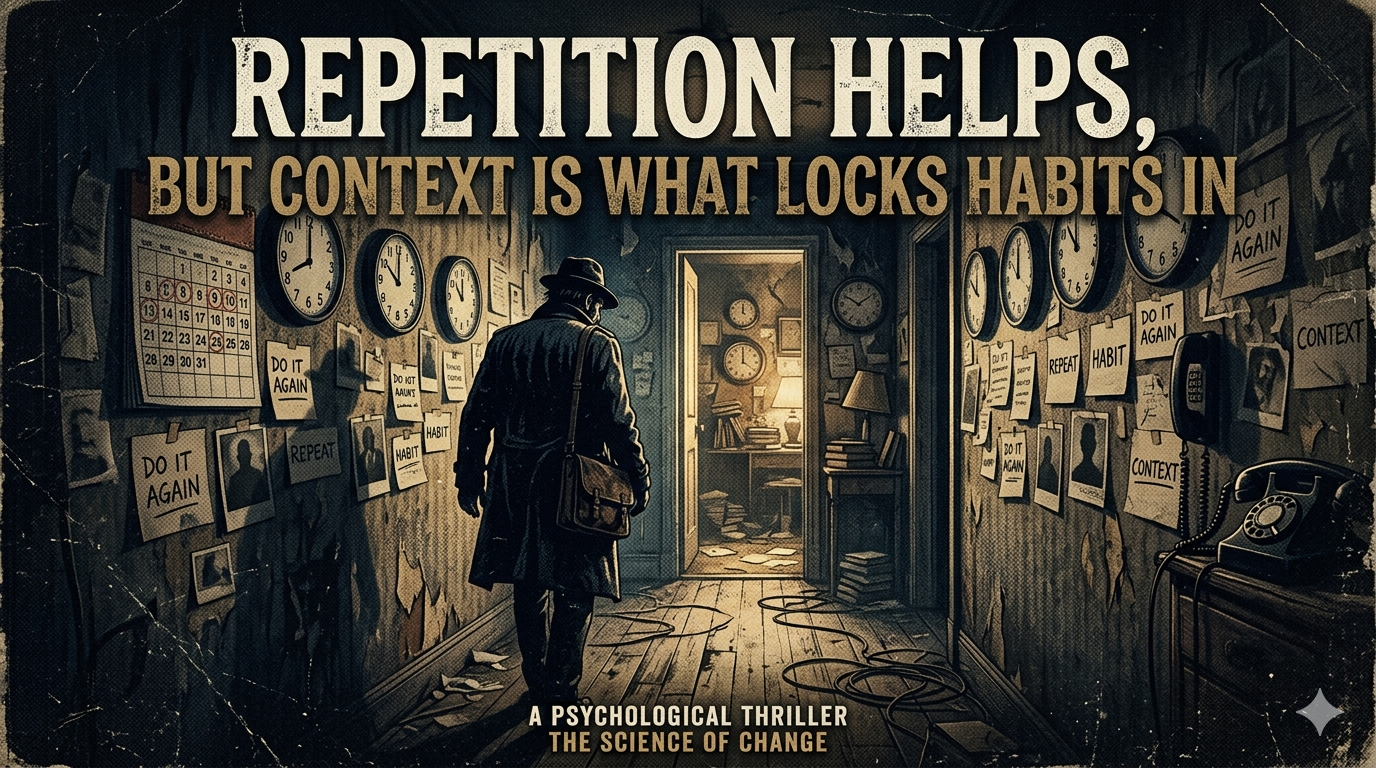
People often talk as if any repeated action will become a habit. Not quite. Repetition matters, but consistency of context matters as much.
If you meditate at wildly different times, in different places, with different triggers, your brain has less opportunity to build a strong cue-behavior link. If you make coffee and then immediately write for ten minutes every weekday, the routine has a much better chance of becoming automatic. The coffee is not magic. It is just stable.
This is why life transitions can disrupt habits so dramatically. Moving cities, changing jobs, starting a relationship, or having a child can break patterns that once felt deeply ingrained. The old cues disappear. That can be frustrating when good habits fall apart, but it also creates an opening. When context changes, behavior becomes more flexible.
In other words, habits are often less about personality than people think. They are heavily shaped by environments that keep nudging the same response.
Emotion plays a bigger role than most people realize
Habits are usually discussed as if they are cold, mechanical patterns. In reality, emotion is often part of the engine.
Behaviors that reduce stress, ease discomfort, or create a sense of reward can become especially sticky. That is true whether the habit looks productive or destructive. Going for a walk after a difficult meeting can become a healthy stress-regulation habit. So can pouring a drink, picking at your nails, or disappearing into online shopping.
This is one reason bad habits are not always replaced by simply removing them. If the behavior serves an emotional function, something has to take over that role. Otherwise, you are not just breaking a routine. You are removing a coping tool.
That does not mean every habit is rooted in deep psychology. Sometimes a habit is just convenience. But when a behavior keeps returning despite your best intentions, it is worth asking what problem it is solving in the moment.
Identity shapes habits, and habits shape identity
One of the most interesting parts of habit formation is the feedback loop between behavior and self-concept. We like to think we act according to who we are. Just as often, we infer who we are from what we repeatedly do.
If you study regularly, you start to feel more disciplined. If you keep canceling plans, you may start telling yourself you are flaky or socially drained. These identity stories matter because they change what feels natural next.
This can help or hurt. On the helpful side, identity makes habits more durable. A person who sees themselves as “someone who trains” is less dependent on daily motivation. On the harmful side, people can get trapped by self-labels. If you believe you are “just bad at routines,” every missed day starts feeling like proof.
A better approach is to treat identity as evidence-based but flexible. Habits are formed through repeated behavior, and identity often follows that pattern. You do not need to become a whole new person before acting differently. Often, the new identity is the byproduct of enough small repetitions.
Why some habits form quickly, and others never stick
There is no universal timeline for habit formation. The often-repeated claim that habits take 21 days is more folklore than science. Some behaviors become fairly automatic within weeks. Others take months. Some never become effortless because they remain effortful by nature.
The speed depends on several factors: how simple the behavior is, how often it is repeated, how stable the context is, and how rewarding it feels. Drinking a glass of water after brushing your teeth is easier to automate than writing 1,000 words every morning. The first behavior is short, clear, and low-friction. The second depends on energy, focus, and time.
This is where a lot of self-help advice goes wrong. It treats all habits as if they are structurally identical. They are not. A tiny administrative habit and a major lifestyle change do not ask the same thing from your brain.
How to use psychology to build better habits

If you want a habit to form, make the cue obvious and the behavior easy enough to repeat under ordinary conditions, not ideal ones. That sounds almost too simple, but it is the practical heart of the research. The less a behavior depends on motivation spikes, the more likely it is to last.
It also helps to anchor the behavior to something that already happens reliably. Existing routines are powerful because they reduce the memory burden. You are not asking yourself to remember a brand-new task out of nowhere. You are attaching it to a pattern already in place.
Rewards matter too, but not always in the flashy sense. Immediate satisfaction helps the brain learn, especially early on. That could mean a visible checkmark, a sense of completion, or simply the relief of having done the thing. Long-term benefits are psychologically weak when the short-term experience is unpleasant.
And if you are trying to break a habit, it usually works better to disrupt the cue or increase friction than to rely on pure restraint. Put the phone in another room. Change the route that takes you past the vending machine. Remove the trigger that keeps making the old response easy.
The larger point is that successful habit change is rarely about becoming stricter with yourself. It is about becoming more accurate about what behavior actually runs on.
The myth of perfect consistency
One missed day does not destroy a habit. But people often interpret small lapses as total failure, which creates the real problem. Once a behavior becomes tied to all-or-nothing thinking, a minor interruption can turn into abandonment.
Psychologically, it is more useful to think in terms of trend and recovery. Strong habits are not built by perfect streaks. They are built by returning quickly enough that the pattern remains intact. Missing once is noise. Repeating the miss until it becomes the new normal is what changes the habit.
That mindset is not just kinder. It is more scientifically honest. Human behavior is variable. Stress, travel, illness, workload, and emotion all affect what is possible on a given day.
If there is one thing worth keeping from all of this, it is this: habits are not proof of virtue or failure. They are patterns your brain has learned. And learned patterns can be revised, one repeated choice at a time.